--%>

Cross-elasticity of demand

Cross-elasticity of demand:

The receptiveness of demand to modifications in prices of associated goods is termed as cross-elasticity of demand (i.e., associated goods might be substitutes or complementary goods). In another words, it is the receptiveness of demand for commodity x to the modification in the price of commodity y.
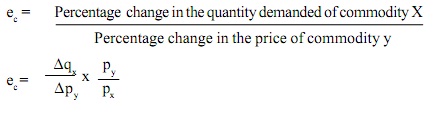
1714_cross elasticity of demand.jpg

The relationship among x and y commodities might be substitutive as in the situation of tea and coffee or complementary as in the situation of ink and pen.

   Related Questions in Microeconomics

  • Q : Normal accounting profit with zero

    Accounting profits are normal along with zero economic profits while there is: (1) monopoly power which has not yet been capitalized. (2) unpredicted short run surges within demand for a good. (3) uncertainty therefore unpredictable e

  • Q : Positive sloped labor supply curve Can

    Can someone help me in finding out the right answer from the given options. The monopsonist in labor market faces a: (1) Totally elastic demand for labor. (2) Completely elastic supply of the labor. (3) Completely inelastic supply of the labor. (4) Positively sloped l

  • Q : Enter an industry by barriers to entry

    Barriers to entry: (w) make this complicated or impossible for new firms to profitably enter an industry. (x) uniformly violate U.S. antitrust statutes. (y) are fundamentally technological instead of economic. (z) stimulate aggressive competition.

  • Q : Determine price and quantity by

    The price elasticity of demand at a specified price and quantity is demonstrated by the ratio of the relative as: (w) change within quantity demanded over a specified proportional price change. (x) reciprocal of the price elasticity o

  • Q : Long run for production theory Long run

    Long run for the production theory is a time period across which: (i) All production occurs. (ii) Firms can adjust all their costs and resources. (iii) Bigger firms absorb the smaller firms. (iv) Marginal costs become decreasingly significant. (iv) Im

  • Q : Normal profit Normal profit signifies

    Normal profit signifies zero economic profit. Explain why?

  • Q : Output produces by monopolistic

    This monopolistic competitor generates Q0 output where is: (1) MR = MC. (2) MSB > MSC. (3) average cost is not minimized. (4) P = ATC. (5) All of the above.

    Q : Oligopoly and the law An illegal

    An illegal practice from an oligopolistic firm would be: (w) price leadership. (x) direct price collusion with rivals. (y) non-price competition. (z) mutual interdependence in price and output decisions. I need a g

  • Q : Legal form of business in United States

    Can someone help me in finding out the right answer from the given options. Which of the given below is not a legal form of the business in United States? (1) Partnership. (2) Corporation. (3) Limited partnership. (4) Producer cooperative.  (5) All the above are

  • Q : Cross-elasticity of demand

    Cross-elasticity of demand: The receptiveness of demand to modifications in prices of associated goods is termed as cross-elasticity of demand (i.e., associated good