--%>

Problem of Nash Equilibrium

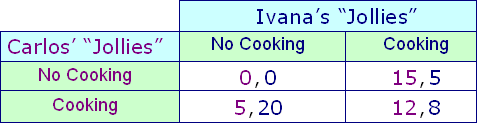
Carlos and Ivana are room-mates and friends. Carlos and Ivana eat together despite who cooks on a given night. Within this payoff matrix, Nash equilibrium could never be obtained in that: (w) neither Carlos nor Ivana cook, nor do they eat. (x) Carlos alone cooks for both of them. (y) Ivana alone cooks for both of them. (z) Carlos and Ivana share the cooking chores, and after that they eat together.
2054_Problem on Nash Equilibrium.png

Can someone explain/help me with best solution about problem of Economics...

   Related Questions in Microeconomics

  • Q : Differentiated goods in monopolistic

    Several other market structures may pivot around goods which are heterogeneous, although the market structure which absolutely needs goods to be differentiated within the minds of consumers is. (i) perfect competition. (ii) pure competition. (iii) mon

  • Q : Problem on market demand for toys

    Booming toy sales throughout December usually reflect rises in: (1) The quantity of toys demanded.  (2) Market demand for toys. (3) Production costs. (4) Infantile consumerism. Can someone please help me in finding out the acc

  • Q : Problem on average retail price and the

    Table indicate the average retail price of milk and the Consumer Price Index in the year 1980 -1998. 1010_Average</span></p>
                                        </div>
                                        <!-- /comment-box -->
                                    </li>
   
   </td>
	</tr><tr>
		<td>
       
      <li>
                                        <div class=

    Q : Compare firms with substantial market

    Compared to Firms A and B as well as C, Firm D is: (1) a firm along with substantial market power. (2) a pure price taker and quantity adjuster. (3) least possible to generate economic profit in the long run. (4) a total revenue maximizer when it produces output level

  • Q : Definition if pure monopsonist Can

    Can someone please help me in finding out the accurate answer from the following question. The pure monopsonist: (1) Is the sole buyer of a specific good or resource in the given market. (2) Can adjust just quantity and therefore is a price-taker in input market. (3)

  • Q : Economies of scale in natural monopoly

    Economies of scale which are substantial relative to market demand result within the market evolving to a: (w) contestable market. (x) collusive oligopoly. (y) natural monopoly. (z) "high tech" industry.

    Q : Private demands and supplies to assign

    Reliance on private demands and supplies to assign goods and resources is least certain to outcome an economically ineffective solution just because: (i) Producers encompass monopoly power. (ii) A good is non-rival and non-exclusive. (iii) Consumption

  • Q : Changes in dollar receipts from sales

    The change within a firm’s dollar receipts from sales when this produces and sells one additional unit of output is termed as: (w) price. (x) marginal revenue. (y) average revenue. (z) contribution to overhead. Can anybody su

  • Q : Expectations in market demands for

    Present market demands for most of the durable goods tend to rise if: (1) Their prices are predicted to rise in the near future. (2) Consumers expect growth in supplies of substitutes. (3) Technological advances make present models obsolete. (4) The p

  • Q : Predictable results of unexpected

    Predictable results of unexpected development of demand for a competitively produced good comprise increases and in that case gradual decreases in the: (w) price of the good and the profits of producers. (x) consumer surplus derived from the good. (y)