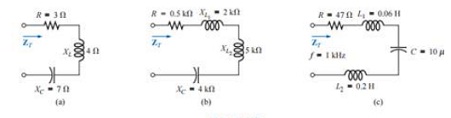
Calculate the total impedance of the circuits
Response to the following problem:
Calculate the total impedance of the circuits of Figure. Express your answer in rectangular and polar forms, and draw the impedance diagram.
Make sure you use enough details to support your answer.
Expected delivery within 24 Hours
Say "Charge It" with Your Cell Phone Wireless operators, credit card companies, and retailers are working on a technology
Find the type and impedance in ohms of the series circuit elements that must be in the closed container of Figure.
Explain to the client the main differences between simple interest versus compound interest.
Leadership is defined as an organizational behavior that involves influencing the behavior of other team members and other staffs to work on the pre-determines
Express your answer in rectangular and polar forms, and draw the impedance diagram.
How we should build brand? It should be internationally to reach correct audience. Those audience should be of business target users to get good visibility
What insights do you take from the article Primal Leadership? Consider the following:
The leader's ultimate role in social change, however, turns largely of his/her ideological leadership
You can choose between the following rent payments: (a) A lump sum cash payment of $100,000
1944767
Questions Asked
3,689
Active Tutors
1460650
Questions Answered
Start Excelling in your courses, Ask a tutor for help and get answers for your problems !!
Question: How do the taste and nature of herbs contribute to their therapeutic actions in traditional Chinese medicine?
Problem: Patient identification errors can cause an incredible amount of risk when a patient is being treated by a healthcare professional.
Which combination of points is known as the 'Four Gates' and is used to clear Wind from the head and has a calming effect?
Question: Which of the following best describes the primary function of Spring points in Traditional Chinese Medicine (TCM)?
describes a key difference between acupuncture and herbal therapy in treating patterns of Deficiency and Excess in traditional Chinese medicine?
What is the clinical significance of the slightly cloudy CSF? Calculate the CSF Glucose:Plasma Glucose ratio. Is the result within expected limits?
Question: What role do the extraordinary vessels play regarding Qi?