--%>

Workers volunteered to work in purely competition

Even though workers volunteered to work as "for free", such purely competitive firm would never hire more than: (i) L2 workers. (ii) L3 workers. (iii) L4 workers. (iv) L5 workers. (v) L6 workers.
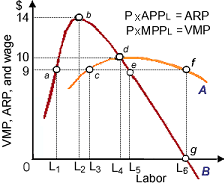
241_Demand for Labor.png

Can anybody suggest me the proper explanation for given problem regarding Economics generally?

   Related Questions in Microeconomics

  • Q : Production and consumption of good of

    Production and consumption of a good is most probable to be economically inefficient in a private market system while private decisionmakers: (i) are affected by government policymakers. (ii) avoid how the activity generates benefits on non-decisionma

  • Q : Thorstein Veblen-Biography Thorstein

    Thorstein Veblen is most particularly remembered for arguing that: (i) Consumer surplus is maximized by setting the marginal utility equivalent to price. (ii) National income [or NI] equivalents gross domestic product [or GDP] in circular flow model.

  • Q : Define marginal cost Marginal cost : It

    Marginal cost: It is the change in sum cost by generating one more or less unit of output.

  • Q : Reduced monopoly power by oligopolistic

    The allocative inefficiency commonly related with the exercise of market [i.e., monopoly] power tends to be reduced when oligopolistic firms: (1) differentiate their products by competitive advertising. (2) price discriminate based upon the price elas

  • Q : Minimum value of investment multiplier

    Minimum value of investment multiplier: Investment multiplier K=1/1-mpcWhen mpc = 0 then K=1/1-0 = 1 that is the minimum value of investment multiplier

  • Q : Formula for primary deficit What is the

    What is the formula for primary deficit? Answer: Primary deficit = fiscal deficit – interest payment.

  • Q : Corporations stockholders not liable

    The corporation’s stockholders are not personally liable for the debts of firm since: (1) The Corporation is considered as a legal person, separate from its owner. (2) Usually there are too many stockholders to try to hold them all accountable. (3) In a corporat

  • Q : Purchasing low selling high Purchasing

    Purchasing low in one market and concurrently selling at a high price in another is NOT a mechanism which: (i) Rises supply in the low-price market. (ii) Risklessly produces profits. (iii) Is termed as arbitrage. (iv) Decreases price differentials among markets. (e) I

  • Q : Exclusivity ratio of ratio while price

    The percentage change within quantity supplied divided through the percentage change within price is an approx measure of a good's: (w) unitary margin. (x) price elasticity of supply. (y) exclusivity ratio. (z) price elasticity of demand.

    Q : Resource market in equilibrium demand

    When the resource market shown in this illustrated figure is initially within equilibrium along with demand curve D0: (w) owners of these resources currently receive no economic rents. (x) economic rent is specified by area