--%>

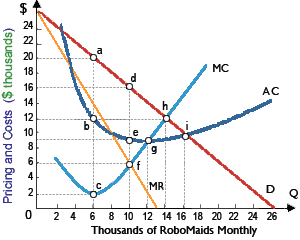
Unitary price elasticity of demand

The output of RoboMaids consequent to the point where demand has unitary price elasticity is approximately: (i) 2,000 robots weekly. (ii) 4,000 robots monthly. (iii) 6,000 robots monthly. (iv) 10,000 robots monthly. (v) 13,000 robots monthly.
2100_Elasticity and profit.png

Can anybody suggest me the proper explanation for given problem regarding Economics generally?

   Related Questions in Microeconomics

  • Q : Perfectly inelastic supply of labor

    Glynn’s supply of labor is perfectly inelastic at: (1) point a. (2) point b. (3) point c. (4) point d. (5) point e. 2</span></p>
                                        </div>
                                        <!-- /comment-box -->
                                    </li>
   
   </td>
	</tr><tr>
		<td>
       
      <li>
                                        <div class=

    Q : Marginal cost Give the answer of

    Give the answer of following question. Refer to the given data. The marginal cost of producing the sixth unit of output is: A) $24. B) $12. C) $16. D) $8. 432_f</span></p>
                                        </div>
                                        <!-- /comment-box -->
                                    </li>
   
   </td>
	</tr><tr>
		<td>
       
      <li>
                                        <div class=

    Q : Present Value of Future Income The

    The interest rate ____ as well as the present value of future income ____ when the preference for current income over the future income weakens. (w) falls; rises. (x) rises; falls. (y) falls; falls. (z) rises; rises.

    Q : Price elasticity of demand coefficient

    In this demonstrated figure, there the price elasticity of demand coefficient is: (1) one at the midpoint. (2) greater than one in range a. (3) less than one in range b. (4) falling along with movements down along the demand curve. (5) All of the abov

  • Q : Price cross-elasticities of demand When

    When the price of thermal underwear is increased from $12 to $18 per pair, because of the quantity of cross country snow skis to decline by 1,200 to 800 pairs annual, such goods are ____ and the price cross elasticity of demand equiva

  • Q : Monopolist in the long run Within the

    Within the long run, here a monopolist: (w) will produce a positive economic profit. (x) will produce an economic profit of zero. (y) may incur an economic loss. (z) will produce an economic profit of zero or greater.

    Q : Define progressive in taxes as

    Line T0 depicts a tax system which is: (1) progressive. (2) recessive. (3) proportional. (4) biased. (5) regressive. 1577_</span></p>
                                        </div>
                                        <!-- /comment-box -->
                                    </li>
   
   </td>
	</tr><tr>
		<td>
       
      <li>
                                        <div class=

    Q : Characterized monopolistic competition

    Within the long run a monopolistically competitive firm will not be characterized through: (w) zero economic profit. (x) price greater than marginal revenue. (y) production at lowest possible average total cost. (z) price greater than marginal cost.

  • Q : Occurrence of disagreements between

    Disagreements between economists occur most commonly within the area of: (1) microeconomic theory. (2) normative aspects of economic policy. (3) positive statements. (4) "common sense." (5) mathematical economics. I need your point

  • Q : Computing Present Value for a Perpetuity

    When all US Treasury bonds are perpetuities that annually pay the sum of one thousand and 00/100 dollars [$1000] per annum, always, to the holder of this bond starting one year from today, at an interest rate of 4 percent, the price of this bond is: (