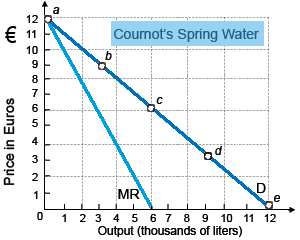
Unitary price elasticity demand
For Cournot’s Spring Water the demand has unitary price elasticity at: (i) point a. (ii) point b. (iii) point c (iv) point d. (v) point e. Can anybody suggest me the proper explanation for given problem regarding Economics generally?
For Cournot’s Spring Water the demand has unitary price elasticity at: (i) point a. (ii) point b. (iii) point c (iv) point d. (v) point e.
Can anybody suggest me the proper explanation for given problem regarding Economics generally?
Can someone help me in finding out the right answer from the given options. When the wage rate paid for the labor rises, then: (i) Supply of labor raises (ii) Opportunity cost of the leisure increases. (iii) Workers always supply additional labor. (iv) Level of the na
Income elasticity of demand: Income elasticity of demand is the degree of receptiveness of demand to the modification in income. Q : Proprietorships-Limited liability Which Which of the given below is not a benefit of the sole proprietorship? (i) Limited liability. (ii) Easiness of organization. (iii) Flexibility. (iv) Freedom from govt. regulation. Choose the right answer from the above options.
Which of the given below is not a benefit of the sole proprietorship? (i) Limited liability. (ii) Easiness of organization. (iii) Flexibility. (iv) Freedom from govt. regulation. Choose the right answer from the above options.
According to the equality standard of income distribution: (i) an equal distribution of income maximizes society’s economic welfare. (ii) income must be divided in proportion to need. (iii) income must be commensurate with productivity. (iv) fac
A mix of heterogeneous goods and many potential buyers and sellers which are free to enter or exit the market within the long run are among essential conditions for an industry to be: (1) a monopoly. (2) purely competitive. (3) an oli
Can there be certain fixed cost in long run? If not why? Answer: No, there can’t be any fixed cost in long run. The main reason is that there is no fixed inpu
Different forms of capital account transactions: A) Private Transactions: There are transactions which affect the liabilities and assets of individuals. Q : Firms and the Transaction Costs Can Can someone help me in finding out the right answer from the given options. The survival of all firms eventually depends on the capability to: (i) Decrease transaction costs to consumers. (ii) Produce economic gain. (iii) Maximize the value of output for given cost. (
Can someone help me in finding out the right answer from the given options. The survival of all firms eventually depends on the capability to: (i) Decrease transaction costs to consumers. (ii) Produce economic gain. (iii) Maximize the value of output for given cost. (
In the following diagram, the elimination of discrimination is best depicted by: 1) a move from C to E. 2) an inward shift of the production possibilities curve. 3) a move from A to D. 4) a move from E to C. Q : Time Estimates for Individual Time Estimates for Individual Activities: A) Weighted Average Activity Time, t = (a + 4m + b)/6B) Standard deviation of activity times, σt = (b-a)/6C) Standard d
Time Estimates for Individual Activities: A) Weighted Average Activity Time, t = (a + 4m + b)/6B) Standard deviation of activity times, σt = (b-a)/6C) Standard d
18,76,764
1953572 Asked
3,689
Active Tutors
1442901
Questions Answered
Start Excelling in your courses, Ask an Expert and get answers for your homework and assignments!!