--%>

Total variable costs in monopolistic competition

When this firm produces 5,000 units of output monthly in this demonstrated figure, in that case its total variable costs equal as: (w) $75,000 per month. (x) $15,000 per month. (y) $18,000 per month. (z) $3,000 per month.
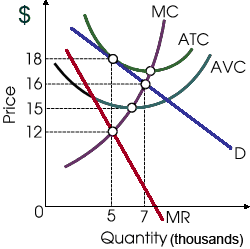
818_Monopolistic Competition1.png

I need a good answer on the topic of Economics problems. Please give me your suggestion for the same by using above options.

   Related Questions in Microeconomics

  • Q : Problem on change in preferences Can

    Can someone help me in finding out the right answer from the given options. Tim liked to snack on slim jims on fishing; however his friend Earl for all time brought beef jerky. Tom slowly developed a taste for jerky and at present buys it more frequently than slim jim

  • Q : Problem related to budget line Refer to

    Refer to the budget line illustrated in the diagram given. If the consumer's money income is $20, the: 1) prices of C and D cannot be determined.2) price of C is $2 and the price of D is $4. 3) consumer can obtain a combination of 5 units of both C and D. 4)

  • Q : Non-discriminating firm through

    The non-discriminating organization with monopsony power in the labor market confronts the: (i) Wage rate which consistently surpasses the marginal revenue. (ii) MRP less than w. (iii) MFC which surpasses w. (iv) Monopolistic seller of the organization’s output.

  • Q : Characterized purely-competitive markets

    Purely-competitive markets are NOT characterized through: (i) substantial barriers to entry and exit. (ii) many small potential buyers. (iii) many small potential sellers. (iv) homogeneous products. (v) zero long-run economic profits.

    Q : Competitive advertising as waste of

    Economists have conventionally concluded which, from the vantage point of society as an entire, competitive advertising in that case: (1) enables consumers to make more efficient economic choices. (2) is a waste of resources. (3) cons

  • Q : Average productivity of labor When the

    When the capital-to-labor (K/L) ratio rises, the: (1) productivity of capital tends to increase. (2) profitability of capital investments will raise. (3) average wages paid to labor will probably decrease. (4) average productivity of labor generally i

  • Q : Average Product and Marginal Product

    State the relationship among Average Product and Marginal Product? A) If MP > AP, then AP is rising B) If MP = AP, then AP is maximum C) If MP < AP, then AP is falling

  • Q : Market power in the output market The

    The profit-maximizing firm which is perfectly competitive in the resource market however which consists of market power in the output market will hire the labor at a point where: (1) VMP = MRP = MFC = w. (2) VMP>MRP=MFC=w. (3) VMP=MRP=MFC>w. (4)

  • Q : Implication of price discrimination

    Price discrimination implies: (1) charging different prices for identical goods that have identical production costs. (2) paying wages based on race or sex quite than productivity. (3) exploiting the working masses by charging the highest single price

  • Q : Unitarily price elastic supply for

    Supply is unitarily price elastic for all quantities and prices upon: (i) supply curve S1. (ii) supply curve S2. (iii) supply curve S3. (iv) supply curve S4. (v) supply curve S5.

    Discover Q & A

    Leading Solution Library
    Avail More Than 1426508 Solved problems, classrooms assignments, textbook's solutions, for quick Downloads
    No hassle, Instant Access
    Start Discovering

    18,76,764

    1958947
    Asked

    3,689

    Active Tutors

    1426508

    Questions
    Answered

    Start Excelling in your courses, Ask an Expert and get answers for your homework and assignments!!

    Submit Assignment

    ©TutorsGlobe All rights reserved 2022-2023.