--%>

Split roughly burden of tax

The burden of an excise (i.e., per unit) tax would be divide roughly fifty by fifty on consumers and suppliers of the taxed good within: (w) Panel A. (x) Panel B. (y) Panel C. (z) Panel D.
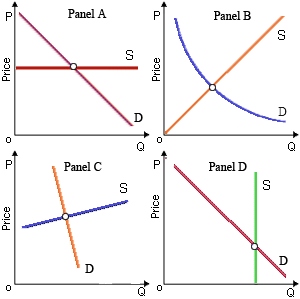
1911_Price Elasticities and Tax Burdens.png

Hello guys I want your advice. Please recommend some views for above Economics problems.

   Related Questions in Microeconomics

  • Q : Production Costs in generating goods

    Production possibilities frontiers be inclined to concave (or bowed out) from the origin as: (1) goods differ in their capacities to gratify individual needs. (2) A land, labor and capital mix is needed for all the production. (3) People vary in their

  • Q : Price elasticity when total revenue

    Total revenue grows while the price of a good is cut when the price elasticity of: (w) demand exceeds the price elasticity of supply. (x) substitute goods is less than one. (y) supply is into a relatively elastic range. (z) demand is

  • Q : Hello hello how to make system analysis

    hello how to make system analysis of work

  • Q : Effects of increasing the price raise

    Increasing the price as in demonstrated figure for DVD games will raise total revenue at the entire prices: (w) on this demand curve. (x) above $30. (y) below $30. (z) below $25. Hey friends please give your opinio

  • Q : Problem on Market Power and Demand for

    Can someone help me in finding out the right answer from the given options. Imperfect competition in the product markets outcomes in: (i) Less labor hired than when product markets were competitive. (ii) Above the equilibrium wages being paid by the monopolists. (iii)

  • Q : Monopoly Profits by Capitalization

    People who seek monopoly profits by buying the assets of successful monopolists will probably: (w) receive only normal returns onto the investment. (x) realize capitalized profits (y) attain monopoly economic profits. (z) thwart competition by innovating procedures of

  • Q : Illustration of Cartels The

    The Organization of Petroleum Exporting Countries (OPEC) is an illustration of: (w) a monopoly. (x) monopolistic competition. (y) a cartel. (z) decentralized communism. Can someone explain/help me with best solution about problem o

  • Q : Problem on Equilibrium price What

    What happens to equilibrium price if increase in demand is equivalent to increase in supply? Answer: In case of equivalent increase in demand and supply the equilib

  • Q : Supply in the short run and long run

    Supply is too elastic (contain a smaller coefficient) within the long run than in the: (w) short-run in competitive, constant-cost industries. (x) short-run in competitive, increasing-cost industries. (y) market period in virtually all industries. (z) All of the above

  • Q : Boycotts concerning problem People who

    People who decline to buy the products of a firm whose activities they disapprove, especially whenever such rejection is intended to support the employees who are on strike, and who advise others to not purchase such products, or to not deal with these firms, are enga