--%>

Shifting of market for productivity increment

When the U.S. soybean market is primarily in equilibrium on S0D0, and in that case a new fertilizer raises farm productivity and concurrently, foreigners are permitted greater access to U.S. soybean, there the market shifts to: (1) S2D1. (2) S0D2. (3) S1D1. (4) S1D2. (5) S2D2.
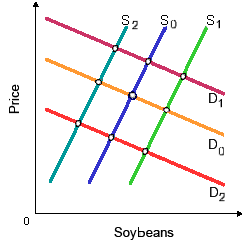
243_soybean market in equilibrium.png

Please choose the right answer from above...I want your suggestion for the same.

   Related Questions in Managerial Economics

  • Q : Move downward demand for labor The

    The demand for labor would move downward like a consequence of: (w) grocery stores buying fewer automatic check-out touchpad computers, and in place of relying more heavily on cashiers to ensure friendly interactions along with customers. (x) declines

  • Q : Credentialism and Occupational Licensing

    Occupational licensing often requires qualifications with small relevance for performance in a specific position before an individual can legally be hired. Artificial and inefficient barriers to the practice of specific occupations, such as dog groome

  • Q : Welfare definition of economics Explain

    Explain the welfare definition of economics? Why is it criticized?

  • Q : Explain the about Fiscal Policy Explain

    Explain the about Fiscal Policy.

  • Q : Determined equilibrium wage from the

    Within a purely competitive labor market, there the firm: (w) sets the wage that the household should accept. (x) should accept the wage demanded by the household. (y) and household arrive at the wage by bargaining. (z) and household should take the e

  • Q : Explain the way of Price Elasticity of

    Explain the way of Price Elasticity of Demand.

  • Q : Free labor in competitive firm When

    When labor was free, in that case this purely competitive firm as in illustrated graph would hire. (1) 600 workers. (2) 700 workers. (3) 800 workers. (4) 900 workers. (5) 1000 workers.

    Q : States the determinants of elasticity

    States the determinants of elasticity?

  • Q : Diminishing Returns and Increasing Costs

    I have a problem in economics on Diminishing Returns and Increasing Costs. Please help me in the following question. The concave (or bowed out) production possibilities frontier means that the opportunity costs are: (i) Constant (ii) Increasing (iii)

  • Q : Perfectly supply of labor in

    The supply of labor within a perfectly competitive market is: (w) an upward sloping curve. (x) a horizontal line. (y) above the MRC. (z) below the MRC. Can someone explain/help me with best solutio