--%>

Marginal Product of Labor

Diminishing returns to labor or questions of monitoring and coordination start to overwhelm any gains by specialization and division of labor within this graph at: (1) point a. (2) point b. (3) point c. (4) point d (5) point e.
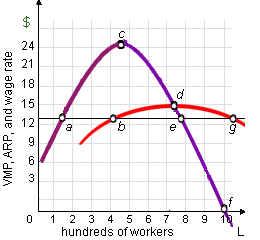
1828_Problem on Demand for Labor.png

Can anybody suggest me the proper explanation for given problem regarding Economics generally?

   Related Questions in Managerial Economics

  • Q : Investment in human capital in market

    Most economists would categorize the bulk of the funds spent upon your college education like: (1) an investment in human capital. (2) financial capitalization. (3) consumption. (4) specific training. (5) personal saving. Please gu

  • Q : Wealth definition of economics Who is

    Who is the father of economics and what is wealth definition of economics?

  • Q : Explain the cost function in briefly

    Explain the cost function in briefly.

  • Q : Explain Simultaneous equation method of

    Explain the Simultaneous equation method of Demand Forecasting.

  • Q : Coupon Electrical utility is offering a

    Electrical utility is offering a security, known as zero coupon bond for sale. The terms of the security are investors pay 2337.57 today to purchase the security and the utility will pay the owner of the security 10000 in ten years time. The government is offering a similar security; except that thi

  • Q : Signaling and Screening Problem Assume

    Assume that you view a degree as a ticket to a high-paying job along with prospects of quick promotion, and that accumulating human capital by learning and studying valuable material is largely not relevant. Your perception is which a college degree f

  • Q : Describe the term Incremental Revenue

    Describe the term Incremental Revenue in details.

  • Q : Purely competitive equilibrium labor

    When this purely competitive labor market is firstly in equilibrium at D0L, S0L, an increase within the price of output will result into equilibrium being attained at: (w) D0L, S0L. (x) D1L, S1L. (y) D2L, S1L. (z) D1L, S0L.

    Q : Substitution effect of wage rate The

    The substitution effect of a small change within the wage rate dominates the income effect for that worker at each wage rate: (w) exceeding $5 per hour. (x) between $5 per hour and $24.99 per hour. (y) exceeding $25.01 per hour. (z) b

  • Q : Income effect at a wage rate The

    The substitution effect of a small change within the wage rate for this worker most strongly goes beyond the income effect at a wage rate of: (1) $5 per hour. (2) $10 per hour. (3) $10 per hour to $25 per hour. (4) $2