--%>

Reduction in quantity

When equilibrium moves from point a to point b in the figure shown below, the only market experiencing a reduction in quantity supplied is illustrated in: (1) Panel A. (2) Panel B. (3) Panel C. (4) Panel D.
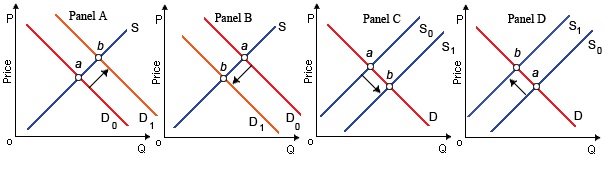
2442_5.jpg

Can someone help me in getting through this problem.

   Related Questions in Macroeconomics

  • Q : Competitive market What do you mean by

    What do you mean by the term Competitive market?

  • Q : Reallocation of resources through budget

    Reallocation of resources: In case, the market economy fails or does not attain the desired social objectives, the government has to interfere via budget and reallocate resources accordingly. Through its budgetary

  • Q : Normative goals of macroeconomic

    Commonly agreed-upon normative goals of macroeconomic policy do not include: (w) high employment. (x) price-level stability. (y) redistributing wealth through the rich to the poor. (z) economic growth. Can someone

  • Q : The failure of the Supercommittee

    Question: Some commentators have argued that the failure of the "Supercommittee" is good thing for the economy?  Do you argree? Answer:

    Q : Monetary policy-how is it decided The

    The practice explores how monetary policy influences the economy and the type of factors which are significant in finding out the Monetary Policy Committee’s decision.

  • Q : Main concerns of microeconomics Can

    Can someone explain/help me with best solution about problem of microeconomics in economic... Main concerns of microeconomics would consist of: (w) rates of inflation. (x) consumer options. (y) rates of unemploymen

  • Q : Conditions through which the supply

    What are the conditions through which the supply curve will shift?

  • Q : Public debt How does an internally held

    How does an internally held public debt differ from an externally held public debt?

  • Q : Problem on full employment level of

    What happens when AD > AS past to full employment level of employment?

  • Q : Difficulty of scarcity People in whole

    People in whole the world confront the difficulty of scarcity at always because: (i) restricted resources and times preclude producing all the goods people need. (ii) greedy capitalist monopolies charge excessively high prices. (iii) international mar