--%>

Shifting of market problem

When this market starts in equilibrium at point e on S0D0 and then young American families rousingly “inherit” furniture as their baby-boomer parents shift into smaller retirement homes, then this market will tend to shift in the direction of: (i) point i. (ii) point h. (iii) point a. (iv) point d. (v) point f.
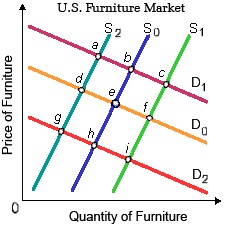
1509_5.jpg

Can someone help me in getting through this problem.

   Related Questions in Macroeconomics

  • Q : Unemployment (a) Do you think that

    (a) Do you think that macroeconomic policy should be designed to achieve a measured unemployment rate of zero?

  • Q : What is Equilibrium What do you mean by

    What do you mean by the term Equilibrium? Also state its proper definition.

  • Q : Functions of central bank Describe

    Describe functions of central bank? Answer: (A) Issue of currency: Central bank is the only authority for the issue of currency

  • Q : Value added technique for national

    What is the alternative name of value added technique of estimating national income? The alternative name of value added technique of estimating national income is production method.

  • Q : Consumer Equilibrium of two goods The

    The consumer reaches equilibrium for any two goods X and Y whenever the: (1) MUx/Px = MUy/Py. (2) MUx/MUy = Py/Px. (3) Utility from X equivalents the utility produced by Y. (4) Point of diminishing returns is arrived at. Can someon

  • Q : Domestic inflation of fixed or managed

    Question: A county with a fixed or managed exchange rate would consider i.___________________ its currency if the country is worried about domestic inflation. ii. Briefly Explain?

    Q : Physical quality of life index DISCUSS

    DISCUSS the experience of high GNP countries and low GNP with regard to PQLI.

  • Q : Problem on Imperfect information

    Imperfect information at times causes consumer’s attempts to maximize their contentment to fail since: (i) Prospects are imperfectly realized, and trial-and-error prototypes can lead to mistakes. (ii) Sellers might exploit asymmetric information

  • Q : For every value of real GDP planned

    planned investment. planned saving. the difference between planned saving and actual saving. the difference between planned investment and actual saving.

  • Q : When people purchase goods People will

    People will purchase goods when their demand prices equivalent or surpass: (i) Transaction costs. (ii) Subjective prices. (iii) Price indexes. (iv) Market prices. (v) Wholesale prices. Please someone suggest me the right answer.