--%>

Purely competitive price takers and quantity adjusters

Different from Firm D, Firms A and B as well as C are all: (w) profitable firms that enjoys significant market power. (x) purely-competitive price-takers and quantity-adjusters. (y) pure monopolies. (z) perfectly inelastic suppliers.
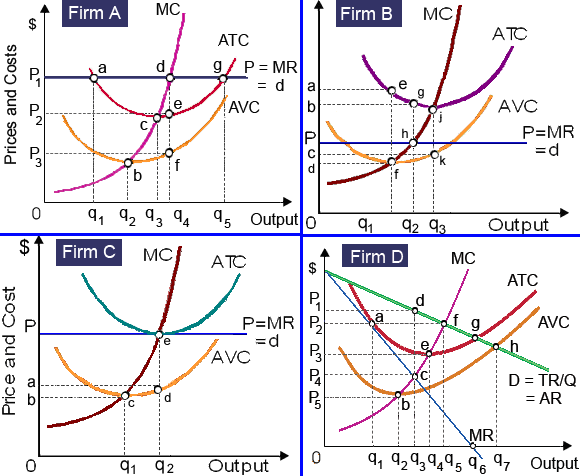
1622_Market Structures.png

Hello guys I want your advice. Please recommend some views for above Economics problems.

   Related Questions in Microeconomics

  • Q : Words of Joseph A. Schumpeter about

    Joseph A. Schumpeter popularized and refined the concept that profits: (i) ultimately derive primarily from innovation. (ii) are necessary compensation to entrepreneurs for bearing uncertainty. (iii) are reduced by bureaucratic inefficiencies in firms

  • Q : Form of Discrimination The form of

    The form of discrimination which probably causes the smallest problems for income distribution is: (1) occupational discrimination. (2) human capital discrimination. (3) price discrimination. (4) personal discrimination. (5) employment discrimination.

  • Q : Investment by profit-maximizing pure

    For such illustrated figure profit-maximizing pure competitor, there area aPed shows: (1) fixed cost (TFC). (2) average fixed cost (AFC). (3) the lowest possible economic loss. (4) maximum economic profits. (5) the rate of return on investment. <

  • Q : Marginal revenue product of labor The

    The monopsonist will hire labor till the labor's marginal resource cost equivalents the: (1) Marginal revenue product of the labor. (2) Marginal physical product. (3) Value of average product of the labor. (4) Price of the labor. C

  • Q : Charge a price by monopolists Most

    Most monopolists whom do not price discriminate and that operate effectively in the long run are capable to charge a price: (w) greater than minimum average total costs [ATC]. (x) less than MR. (y) less than marginal costs [MC]. (z) less than which of

  • Q : Problem on Buyers market I have a

    I have a problem in economics on Buyers market. Please help me in the following question. The buyer’s market is a market in which: (1) Queuing to secure goods is very common. (2) The present market price is beneath equilibrium. (3) Quantity dema

  • Q : Demand when coefficient of price

    When the coefficient of price elasticity for eggs is 0.67, in that case the demand for eggs is: (w) relatively elastic. (x) relatively inelastic. (y) an upward sloping demand. (z) a horizontal demand. I need a good

  • Q : Define demand curve where quantity

    At the whole prices where quantity demanded is zero, there the: (w) slope of the demand curve is zero. (x) price elasticity of demand is zero. (y) supply curve has infinite slope. (z) price elasticity of demand is imperfectly defined.

    Q : Determine relatively price elasticity

    A price elasticity of demand of 2.0 implies that at that point, the demand curve is: (w) income elastic. (x) relatively price elastic. (y) relatively price inelastic. (z) unitarily price elastic. I need a good answ

  • Q : Good taxed revenue of price inelastic

    Government tax revenue would raise most from a specified tax when the good taxed contain a relatively: (w) price elastic demand. (x) price inelastic demand. (y) unitary price elastic demand. (z) flatter demand curve.

    Discover Q & A

    Leading Solution Library
    Avail More Than 1455917 Solved problems, classrooms assignments, textbook's solutions, for quick Downloads
    No hassle, Instant Access
    Start Discovering

    18,76,764

    1932263
    Asked

    3,689

    Active Tutors

    1455917

    Questions
    Answered

    Start Excelling in your courses, Ask an Expert and get answers for your homework and assignments!!

    Submit Assignment

    ©TutorsGlobe All rights reserved 2022-2023.