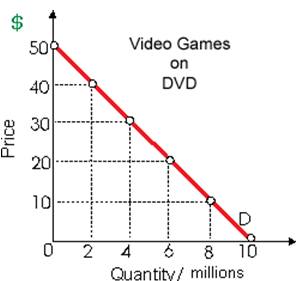
Lowering prices raises total revenue for demand elasticity
Lowering prices will raise total revenue from DVD game sales at all prices as: (w) on this demand curve. (x) below $25. (y) above $25. (z) below $30. How can I solve my economics problem? Please suggest me the correct answer.
Lowering prices will raise total revenue from DVD game sales at all prices as: (w) on this demand curve. (x) below $25. (y) above $25. (z) below $30.
How can I solve my economics problem? Please suggest me the correct answer.
When increased demand causes the price of main beluga caviar to climb from $2750 to $3250 per pound and consequently world production rises from 24 to 40 tons yearly, its caviar has a price elasticity of supply approx
Behavior most compatible along with the law of equivalent marginal advantage occurs while: (w) shoppers exhaust their budgets upon nondurables and services. (x) every firm uses similar markup over cost to set prices. (y) identical twins work in evenly
Purchasing low in one market and concurrently selling at a high price in another is NOT a mechanism which: (i) Rises supply in the low-price market. (ii) Risklessly produces profits. (iii) Is termed as arbitrage. (iv) Decreases price differentials among markets. (e) I
The concept that people must have income in proportion to their productivity is termed as the: (1) equality standard of distribution. (2) productivity standard of distribution. (3) needs standard of distribution. (4) utility standard
I can't discover the answer of this question based on heterodox explanation. Help me out to get through this question. What is the heterodox explanation of the social provisioning procedure?
Within the long run, here a monopolist: (w) will produce a positive economic profit. (x) will produce an economic profit of zero. (y) may incur an economic loss. (z) will produce an economic profit of zero or greater. Q : Problem regarding to demography of Onto average, African-Americans into the U.S., when compared to whites: (1) earn lower incomes. (2) have less education. (3) experience higher rates of unemployment. (4) are less likely to be capable to retire on Social Security. (5) All of the above. Q : Problem on Arbitrage Costs Purchasing Purchasing low in one market and at the same time selling high in the other market is termed as: (1) Gambling. (2) Speculation. (3) Arbitrage. (4) Optioning. (5) Hedging. Find out the right answer from the above options.
Onto average, African-Americans into the U.S., when compared to whites: (1) earn lower incomes. (2) have less education. (3) experience higher rates of unemployment. (4) are less likely to be capable to retire on Social Security. (5) All of the above. Q : Problem on Arbitrage Costs Purchasing Purchasing low in one market and at the same time selling high in the other market is termed as: (1) Gambling. (2) Speculation. (3) Arbitrage. (4) Optioning. (5) Hedging. Find out the right answer from the above options.
Purchasing low in one market and at the same time selling high in the other market is termed as: (1) Gambling. (2) Speculation. (3) Arbitrage. (4) Optioning. (5) Hedging. Find out the right answer from the above options.
Transfer payments and progressive tax policies are being determinate to: (w) reduce disparities in the distributions of income and wealth. (x) shift the Lorenz curve toward a position of less income equality. (y) have no net effect on income equality
The study of the model of pure competition is very significant since this: (w) explains the behavior of most U.S. firms. (x) gives the underpinnings for supply and demand. (y) helps explain why government economic policy is essential. (z) gives a rati
18,76,764
1930854 Asked
3,689
Active Tutors
1421354
Questions Answered
Start Excelling in your courses, Ask an Expert and get answers for your homework and assignments!!