--%>

Purely-competitive market demand

For the purely-competitive cranberry market, as in below figure there Curve H is: (i) industry’s long-run supply curve. (ii) firm’s demand curve in the short run. (iii) industry’s marginal cost curve. (iv) firm’s long run marginal cost curve.
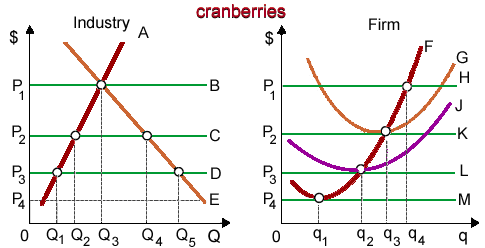
500_demand and supply.png

Can anybody suggest me the proper explanation for given problem regarding Economics generally?

   Related Questions in Microeconomics

  • Q : Problem on facing comparable risks in

    When a firm experiences an accounting profit which is less than the normal profit realized by the firms of comparable size and facing the comparable risks, the firm: (i) Has failed to compute the implicit costs. (ii) Should be facing entry barriers to the industry. (i

  • Q : Changes in price influencing supply

    Describe how changes in the prices of other products influence the supply of a specific product.

  • Q : Annual economic profit of production

    When point e corresponds to $18 per copy for St. Valentine’s Day software, so Prohibition Corporation can produce annual economic profit of at most just about: (i) $100 million. (ii) $140 million. (iii) $200 million. (iv) $300 million. (v) $400

  • Q : Tourist’s use of natural resources What

    What are your views about tourist’s use of natural resources?

  • Q : Nonexistent market supply and power

    HoloIMAGine has patented a holographic technology which creates 3-D photography obtainable to consumers. There is a market supply curve for HoloIMAGine technology: (w) nonexistent since price-maker firms simultaneously set prices as well as quantities

  • Q : Making investment possible in an

    The group which ultimately makes investment in an economy possible is: (1) business firms. (2) households which consume less than their disposable incomes. (3) banks. (4) savings and loan associations. (5) financial tycoons.

    Q : Charge a price by monopolists Most

    Most monopolists whom do not price discriminate and that operate effectively in the long run are capable to charge a price: (w) greater than minimum average total costs [ATC]. (x) less than MR. (y) less than marginal costs [MC]. (z) less than which of

  • Q : Price and quantity supply The

    The positively sloped supply curves exhibit relationships which: (1) Follow from law of demand. (2) Are positive between quantity supplied and price. (3) Are negative between price and the quantity sold. (4) Exist for services however not goods.

  • Q : Requirements for pure competition The

    The needs for pure competition are most intimately met by the market for: (i) domestic (American) steel. (ii) comic books. (iii) sugar-coated cereal within your local grocery store. (iv) stocks and bonds traded on Wall Street after they have been issu

  • Q : Estimate price by price elasticity of

    At the point on the demand curve for RoboMaids where the price elasticity of demand is unitary, the price would be roughly: (i) $10,000, resulting in sales of roughly 16,000 robots monthly. (ii) $13,000, resulting in sales of approxim