--%>

Problem on reduced row-echelon

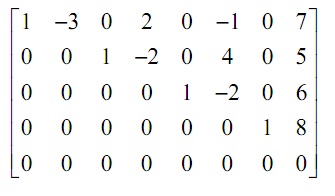
The augmented matrix from a system of linear equations has the following reduced row-echelon form.
280_row echelon method.jpg

(a)  How many equations are there in the system?
(b)  How many variables are there in the system?
(c)  How many of the variables are independent variables?
(d)  Write out the solution set for the system.

   Related Questions in Mathematics

  • Q : Explain Black–Scholes model Explain

    Explain Black–Scholes model.

  • Q : Formal Logic It's a problem set, they

    It's a problem set, they are attached. it's related to Sider's book which is "Logic to philosophy" I attached the book too. I need it on feb22 but feb23 still work

  • Q : Abstract Boolean Algebra I. Boolean

    I. Boolean Algebra Define an abstract Boolean Algebra, B,  as follows:  The three operations are:  +   ( x + y addition) ( x y multiplic

  • Q : Problem on reduced row-echelon The

    The augmented matrix from a system of linear equations has the following reduced row-echelon form. 280_row echelon method.jpg

  • Q : Uniform scaling what is uniform scaling

    what is uniform scaling in computer graphic

  • Q : Explain a rigorous theory for Brownian

    Explain a rigorous theory for Brownian motion developed by Wiener Norbert.

  • Q : State Fermat algorithm The basic Fermat

    The basic Fermat algorithm is as follows: Assume that n is an odd positive integer. Set c = [√n] (`ceiling of √n '). Then we consider in turn the numbers c2 - n; (c+1)2 - n; (c+2)2 - n..... until a perfect square is found. If th

  • Q : State Measuring complexity Measuring

    Measuring complexity: Many algorithms have an integer n, or two integers m and n, as input - e.g., addition, multiplication, exponentiation, factorisation and primality testing. When we want to describe or analyse the `easiness' or `hardness' of the a

  • Q : Theorem-Group is unique and has unique

    Let (G; o) be a group. Then the identity of the group is unique and each element of the group has a unique inverse.In this proof, we will argue completely formally, including all the parentheses and all the occurrences of the group operation o. As we proce

  • Q : Law of iterated expectations for

     Prove the law of iterated expectations for continuous random variables. 2. Prove that the bounds in Chebyshev's theorem cannot be improved upon. I.e., provide a distribution that satisfies the bounds exactly for k ≥1, show that it satisfies the bounds exactly, and draw its PDF. T