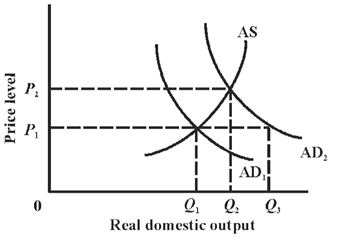
Problem on price level-real domestic output
Refer to the below diagram. Give me answer of this question. If equilibrium real output is Q2, then: A) aggregate demand is AD1. B) the equilibrium price level is P1. C) producers will supply output level Q1. D) the equilibrium price level is P2.
Taxes will be shifted forward completely when supply is positively sloped as well as the demand curve is, there contrary to economic reasoning: (1) perfectly inelastic. (2) perfectly elastic. (3) unitarily elastic. (4) flatter than supply.
Give me the answer of this question. The most important determinant of consumer spending is: A) the level of household debt. B) consumer expectations. C) the stock of wealth. D) the level of income.
The successful employment of expensive marketing techniques through established competitors in an oligopoly: (w) encourages entry by other profit maximizing firms. (x) raises the minimum efficient scale of production for new entrants. (y) acts as a re
When you became an entrepreneur, in that case the transaction costs incurred in containing a luau for your employees would not comprise: (w) filling your car along with gasoline on the way to picking up the pig and poi. (x) time you u
For this purely competitive firm, area P2P1de shows: (1) fixed cost (TFC). (2) losses, but the minimum possible economic loss. (3) average fixed cost (AFC). (4) maximum economic profits. (5) the rate of return on investment.
The greater the price elasticity of demand associate to the price elasticity of supply, then the: (i) greater the legal incidence of any tax burden. (ii) smaller the forward shifting of any tax burden. (iii) smaller the backward shift
A minimum legal price is called a price: (1) floor. (2) guarantee. (3) foundation. (4) stabilizer. (5) subsidy. I need a good answer on the topic of Economic problems. Please give me your suggestion for the same by
Long run economic profits for monopolistic competitors are prohibited by: (w) easy entry and exit. (x) the kinked demand curve. (y) barriers to entry. (z) diminishing marginal returns. Please choos
The supply and demand are affected by the time in sense that the longer the time interval considered, the: (1) Less sensitive sellers and buyers are to price changes. (2) Much sensitive sellers and buyers are to price changes. (3) Bigger is supply and
The Lorenz curve gives an indication of: (w) the poverty rate. (x) dead end poverty. (y) relative poverty. (z) post-transfer poverty. Hello guys I want your advice. Please recommend some views for above Eco
18,76,764
1943249 Asked
3,689
Active Tutors
1447760
Questions Answered
Start Excelling in your courses, Ask an Expert and get answers for your homework and assignments!!