--%>

Price elasticity of demand coefficient

In this demonstrated figure, there the price elasticity of demand coefficient is: (1) one at the midpoint. (2) greater than one in range a. (3) less than one in range b. (4) falling along with movements down along the demand curve. (5) All of the above.
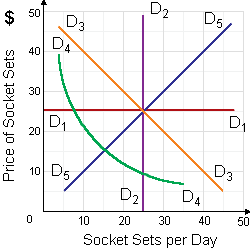
1771_Price Elasticity of Demand.png

How can I solve my Economics problem? Please suggest me the correct answer.

   Related Questions in Microeconomics

  • Q : Internal financing in Corporate Finance

    Can someone help me in finding out the precise answer from the given options. The corporations might get internal financing by: (i) Borrowing from the stockholders. (ii) Reinvesting the corporate income rather than paying it out as the dividends to stockholders. (iii)

  • Q : Combinations of goods in production

    Points exterior to economy’s production possibilities curve exhibit combinations of goods which: (i) Can’t be produced with the economy’s present capacity. (ii) Employ resources proficiently in production. (iii) Don’t utilize t

  • Q : Less equally distribution of wealth In

    In the United States, wealth appears to be: (1) more equitably distributed than income tax burdens. (2) less equally distributed than income. (3) distributed much more equally than in communist countries. (4) weak in generating income for wealthy indi

  • Q : Profit-maximizing monopolistically

    A profit-maximizing monopolistically competitive firm will operate where is: (w) MR > MC. (x) MR = MC. (y) P < MR. (z) P < MC. Can anybody suggest me the proper explanation for given problem regarding

  • Q : Consequence of Rational Ignorance Can

    Can someone help me in finding out the right answer from the given options. Being disappointed whenever you finally learn how some desserts are accessible after you have already told the server at a restaurant that you will try the ‘all-you-can-eat’ buffet

  • Q : Perfectly Elastic Economic Rent A

    A uniform resource price paid for any resource which has an aggregate supply curve which is less than perfectly elastic generates an: (1) exploitation ratio. (2) investment surcharge. (3) accounting profit. (4) economic rent. (5) acce

  • Q : Employed Currency in 1700s In 1700s

    In 1700s what currency was employed?

  • Q : Labor History-Yellow Dog Contracts The

    The Yellow dog contracts are now outlawed, however in the early 20th century such agreements among employers: (1) Not to purchase intermediate goods generated by unionized labor hindered labor market re-forms. (2) And workers specifying that the workers would not conn

  • Q : Equilibrium moves market increase in

    When equilibrium moves from point a to point b, the simple market experiencing a raise in supply is demonstrated within: (w) Panel A. (x) Panel B. (y) Panel C. (z) Panel D.

    Q : Purchasing ratio maximizing the total

    The consumer who spends income and hence the ratio of MUs of all goods purchased equivalents the ratio of their prices is: (i) Maximizing net utility. (ii) Spending too much. (iii) Beyond the point of diminishing negative utility. (iv) Behaving incompatibly through pu