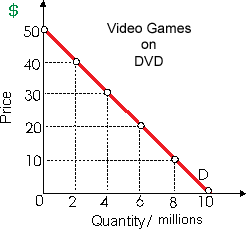
Price elasticity of demand among various prices
The price elasticity of demand as in below illustrated figure for DVD games among prices of $20 and $30 is about: (w) 1.00. (x) 25. (y) 1/25. (z) 1/2. Please choose the right answer from above...I want your suggestion for the same.
The price elasticity of demand as in below illustrated figure for DVD games among prices of $20 and $30 is about: (w) 1.00. (x) 25. (y) 1/25. (z) 1/2.
Please choose the right answer from above...I want your suggestion for the same.
One of the major disadvantages of the corporation is: (i) Double taxation of its gains. (ii) Its incapability to outlive the death of an owner. (iii) Its unlimited liability. (iv) Its inability to increase the financial resources.
The profit-maximizing price for “Silver Screen Classic” of Nostalgia DVDs is: (i) $6 per copy. (ii) $10 per copy. (iii) $12 per copy. (iv) $16 per copy. (v) $20 per copy. Q : Law of Equal Marginal Advantage I have I have a problem in economics on Law of Equal Marginal Advantage. Please help me in the following question. The very last cents spent on each and every good should give up equivalent subjective profits according to the principle of: (i) Subjective pre
I have a problem in economics on Law of Equal Marginal Advantage. Please help me in the following question. The very last cents spent on each and every good should give up equivalent subjective profits according to the principle of: (i) Subjective pre
Onto average, African-Americans into the U.S., when compared to whites: (1) earn lower incomes. (2) have less education. (3) experience higher rates of unemployment. (4) are less likely to be capable to retire on Social Security. (5) All of the above. Q : Produces profit maximizing by marginal All profit maximizing firms makes where marginal revenue: (w) equals marginal cost. (x) equals average variable cost. (y) includes average revenue. (z) is rising. Can anybody suggest me the proper
All profit maximizing firms makes where marginal revenue: (w) equals marginal cost. (x) equals average variable cost. (y) includes average revenue. (z) is rising. Can anybody suggest me the proper
Types of measurement in Metrics: A) Nominal: a nominal scale assigns items to a category. For example, the category may be a simple "yes" or "no." In the case of a family, a nominal scale
Government tax revenue would raise most from a specified tax when the good taxed contain a relatively: (w) price elastic demand. (x) price inelastic demand. (y) unitary price elastic demand. (z) flatter demand curve. Q : What is Marketability What is What is Marketability. Write some points for it.
What is Marketability. Write some points for it.
Within purely competitive industries: (w) short-run market supply curves are positively sloped. (x) long-run market supply curves are positively sloped. (y) short-run supply is more elastic than long-run supply. (z) economic profit exceeds accounting
I have a problem in economics on Profit-maximizing monopolists. Please help me in the following question. Profit-maximizing monopolists exploit the labor since: (i) Workers are paid very less than the value of their average physical products. (ii) The
18,76,764
1951657 Asked
3,689
Active Tutors
1413548
Questions Answered
Start Excelling in your courses, Ask an Expert and get answers for your homework and assignments!!