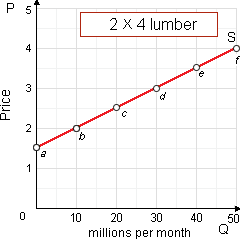
Price elastic of supply between two points
In between point c and d in this supply curve of 2×4s, the price elastic of supply as: (i) 1.0. (ii) 1.6. (iii) 2.2. (iv) 2.8. (v) 3.4. Can anybody suggest me the proper explanation for given problem regarding Economics generally?
In between point c and d in this supply curve of 2×4s, the price elastic of supply as: (i) 1.0. (ii) 1.6. (iii) 2.2. (iv) 2.8. (v) 3.4.
Can anybody suggest me the proper explanation for given problem regarding Economics generally?
LoCalLoCarbo that is Favorite Corporation of fad dieters, which can minimize its average total costs near producing: (i) output q1 at point a. (ii) output q2 at point b. (iii) output q3 at point e. (iv) output q4 at point f. (v) output q5 at point g.<
When an individual or family lacks adequate resources to escape a state of destitution, their circumstances are described as: (1) involuntary poverty. (2) relative poverty. (3) a vicious cycle of poverty (4) institutional poverty. (5) a culture of pov
Differentiate between planned and actual saving and investment. Answer: There is a big difference between (a) planned S and I and (b) Actual saving and investment.<
Nintendo Co. of Japan has been accused of discarding its products (as selling below cost) upon the U.S. market that harms U.S. producers. When true, it is an illustration of: (w) excessive international competition. (x) protectionism. (y) aggressive advertising. (z) p
When a $5 price hike raises the number of tanks of dehydrated water supplied into this market from point a to point b, there elasticity of supply is: (w) 4.5. (x) 3.0. (y) 1.5. (z) 0.5. Q : Imposing the price floors A surplus of A surplus of papayas would involve when: (1) government set a price ceiling of P1. (2) growers expected prices to soar. (3) hurricanes vanished all Central American papaya plantations. (4) government imposed a price floor of P2. (5) seller's supp
A surplus of papayas would involve when: (1) government set a price ceiling of P1. (2) growers expected prices to soar. (3) hurricanes vanished all Central American papaya plantations. (4) government imposed a price floor of P2. (5) seller's supp
what is the Production possibility frontier
Predictions which higher gasoline prices will increase total spending on gas imply such as the demand over the relevant price range that is: (w) unlimited. (x) relatively price elastic. (y) unitarily price elastic. (z) relatively price inelastic.
Significant influences on union non-union wage differentials comprise the: (1) Proportion of an industry which is unionized and the frequency of strikes. (2) Frequency of strikes, inflation and the collective bargaining policies. (3) Collective bargai
If workers know that they are guaranteed a particular weekly wage and can simply find another job at this equilibrium wage, then some workers tend to loaf or shirk. This is an illustration of: (i) Adverse selection. (ii) Moral hazard. (iii) Demand and supply. (iv) Ine
18,76,764
1946738 Asked
3,689
Active Tutors
1461246
Questions Answered
Start Excelling in your courses, Ask an Expert and get answers for your homework and assignments!!