--%>

Price elasticity for quantities and prices

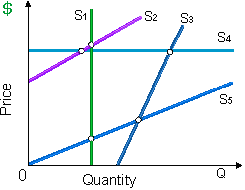
Suppose that all these curves are infinitely long straight lines. There supply curve which is relatively (although not perfectly) price elastic for all quantities and prices is: (1) supply curve S1. (2) supply curve S2. (3) supply curve S3. (4) supply curve S4. (5) supply curve S5.
1069_Price Elasticity of Supply1.png

Hey friends please give your opinion for the problem of Economics that is given above.

   Related Questions in Microeconomics

  • Q : Absolute Poverty of Income A family

    A family whose income leaves this hovering at the brink of survival and that gives only a razor’s edge existence is experiencing: (w) relative poverty. (x) economic shock. (y) financial destitution. (z) absolute poverty.

    Q : Effects of Globalization on Indian

    What do you mean by globalization and its effects on the Indian economy?

  • Q : Demand curve at the current market price

    The demand curve faced through a purely competitive firm at the current market price of: (i) negatively sloped. (ii) horizontal. (iii) perfectly inelastic. (iv) rectangularly hyperbolic. (v) positively sloped.

    Q : Marginal revenue and average revenue

    A firm along with market power faces a downward sloping demand curve since: (w) selling more of the good needs a price cut. (x) marginal revenue should equal average revenue. (y) only pure monopolies face horizontal demand curves. (z)

  • Q : Normal market supply curves I have a

    I have a problem in economics on Normal market supply curves. Please help me in the following question. The actuality that normal market supply curves slope upward is most obviously due to: (i) The lower costs incurred as production rises. (ii) Overti

  • Q : Profit Maximization in Resource Markets

    I have a problem in economics on Profit Maximization in Resource Markets. Please help me in the following question. To make a decision regarding resource hire, the firm should consider: (1) The price of resource. (2) The productivity (MP) of resource. (3) Output price

  • Q : Problem based on GDP Assume nominal GDP

    Assume nominal GDP in the year of 2002 was $100 billion and in the year of 2003 it was $260 billion. The general price index in 2002 was 100 and in 2003 it was 180. Between 2002 and 2003 the real GDP rose by: A) 160 percent. B) 44 percent. C) 37 percent. D) 1

  • Q : Income Distribution and Satisfaction

    Some researchers have determined that citizens of some prosperous countries [for example, Japan] explain themselves as “happy” far less frequently, onto average, than citizens of a few poorer nations [for example, Indonesia]. Nevertheless, almost all studi

  • Q : Illustration of most complete monopoly

    The most complete monopoly by the given list would be: (1) McDonald’s dominance in marketing fast food burgers. (2) the Federal Reserve System [i.e., an arm of the government] issuing all US currency. (3) limiting subsidized low tuitions at stat

  • Q : A purely competitive industry long-run

    The long-run dynamics of purely competitive industry make sure that:( w) surviving firms make positive economic profits. (x) accounting profits will equal economic profits. (y) accounting profits will be zero. (z) economic profits will be zero. <