--%>

Determine price of unitary price elasticity of demand

St. Valentine’s Day software is currently going in version of 6.0. At this point on the demand curve where the price elasticity of demand is unitary, there the price would be approximately: (i) $20, resulting in roughly 16 million copies being sold. (ii) $27, resulting in approximately 13 million copies being sold. (iii) $32, resulting in roughly 10 million copies being sold. (iv) $40, resulting in about 6 million copies being sold. (v) $47, resulting in about 2million copies being sold.
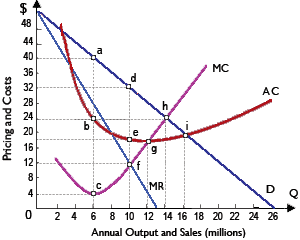
871_software of Elasticity.png

Can anybody suggest me the proper explanation for given problem regarding Economics generally?

   Related Questions in Microeconomics

  • Q : Profit-maximizing to make economic

    This profit-maximizing brickyard of below illustrated figure on the average is, about: (i) making an economic profit of $8 per thousand bricks. (ii) incurring variable costs of $90 per thousand bricks. (iii) suffering an accounting loss of $2 per thou

  • Q : Sole proprietorships and partnerships

    The Sole proprietorships and partnerships account for the ________ percent of all U.S. firms and a _________ percent of sales by the U.S. firms: (1) Large; small. (2) Large; large. (3) Small; small. (4) Small; large. Find out the r

  • Q : Describing the problem of Moral Hazard

    When an NBA all-star bets in opposition to his team in games he plays after getting the money designated in his contract, he would be describing the problem of: (1) Default a version. (2) Over achievement. (3) Moral hazard. (4) Stupidity.

    Q : Constant-cost in short-run

    In a constant-cost, there purely-competitive industry in the short-run: (w) and long-run supply curves are positively sloped. (x) and long-run supply curves are negatively sloped. (y) and long-run supply curves are horizontal. (z) sup

  • Q : Resources and Products Flow Model I

    I have a problem in economics on Resources and Products Flow Model. Please help me in the following question. The eventual owners of all resources and products in the society are as follows: (i) households. (ii) Firms. (iii) The tax-paying public. (iv

  • Q : Demand for product is most elastic at

    From these points in this figure, demand for cheesy fried grits is largely elastic at a price of: (w) P1 and quantity of Q3. (x) P2 and quantity of Q2. (y) P3 and quantity of Q1. (z) P4 and q

  • Q : Reduce total revenue when demand is

    Boosting the price for Pixie’s cheesy fried grits by P2 to P3 will: (w) increases total revenue since demand within inelastic. (x) increase total revenue since demand is elastic. (y) reduce total revenue since demand is inelastic. (z) reduce total revenue since demand

  • Q : Shutdown level of output for a purely

    For a purely competitive firm the shutdown level of output arises where is: (w) total revenue barely covers total fixed costs. (x) market price just equals the minimum of its AVC curve. (y) total revenue equals total cost as (PQ = TFC + TVC). (z) pric

  • Q : Charge a price by monopolists Most

    Most monopolists whom do not price discriminate and that operate effectively in the long run are capable to charge a price: (w) greater than minimum average total costs [ATC]. (x) less than MR. (y) less than marginal costs [MC]. (z) less than which of

  • Q : Transformation of Predictable Income

    The transformation of predictable income streams within wealth is termed as: (i) monetization. (ii) financial arbitrage. (iii) capitalization. (iv) seignorage. (v) capital accumulation. How can I solve my E