--%>

Market period disequilibrium

At the price P1, this purely competitive Christmas tree industry is within: (w) long-run equilibrium. (x) short-run equilibrium. (y) market period disequilibrium. (z) short-run disequilibrium.
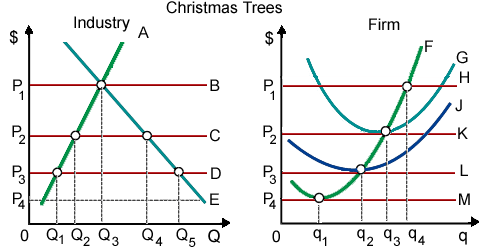
2076_supply and demand1.png

Hello guys I want your advice. Please recommend some views for above Economics problems.

   Related Questions in Microeconomics

  • Q : Signals of economic profits to

    Economic profits are: (1) signals which, for efficiency, more resources must be moved into an industry. (2) rewards to successful innovators. (3) capitalized as wealth when they can be expected over time. (4) a residual to a firm's owners for bearing

  • Q : Labor Unions-Secondary Boycotts

    Whenever a firm consists of a collective bargaining agreement with its employees and unionized employees reject to handle the goods generated by other firms if the workers for other firms are on strike, then the unionized employees are engaged in the: (1) Secondary bo

  • Q : Problem of dockworkers on hiking the pay

    When you were in the ski boat business, your net revenues from selling given numbers of boats would be least influenced by: (i) Govt. increasing fees for boat licenses. (ii) Rises in prices for jet skis. (iii) Pay hikes for dock-workers. (iv) Vacation

  • Q : Export transactions Select the right

    Select the right answer of the question. U.S. export transactions create: A) a U.S. demand for foreign monies and the satisfaction of this demand decreases the supplies of dollars held by foreign banks. B) a U.S. demand for foreign monies and the satisfaction of this

  • Q : Market Power and Monopsony Power-

    Assume that a firm with market power in the output market wants to develop and that hiring more workers needs it to raise salaries 8 percent for all the workers. Output prices will most likely: (i) Increase 8 percent to cover the wage rise. (ii) Increase less than 8 p

  • Q : Prices and outputs in the short run All

    All output markets which are less than purely competitive are characterized through: (1) domination of the market by some large firms. (2) individual firms that are very small to affect their prices. (3) freedom of entry and exit in the long run. (4)

  • Q : Existence of purely competitive farm in

    This purely competitive rose farm would most likely exit in this industry with the long run when the wholesale price per dozen roses fell below: (i) $4.50 per dozen roses. (ii) $5.00 per dozen roses. (iii) $5.50 per dozen roses. (iv) $6.00 per dozen r

  • Q : Public Policy and the Distribution of

    The two policies that most likely account for most of the trend toward greater income equality during 1929 and 1975 are: (w) improved educational opportunities, and tax and transfer policies. (x) reduced sex discrimination and public availability of b

  • Q : Total costs incur by profit-maximizing

    Hybrid Roses is the merely florist in 60 miles of Presidio, Texas. When total fixed costs (for example, rent and utilities) are $9 per hour, that profit-maximizing monopolist will incur total costs of around: (w) $20 per hour. (x) $27

  • Q : Exploitation-Competitive Markets The

    The removal of exploitation of the labor wage payments beneath the value to society of each and every individual worker’s productive contribution is automatic when business decision makers: (i) Should set wages via collective bargaining agreements with the labor