--%>

Increasing cost industries in long run equilibrium price

When cranberry farming is an increasing constant cost industry and that firm is typical, in that case an increase within the market demand for cranberries will give in a long run equilibrium price as: (i) less than P1. (ii) greater than P2. (iii) less than P2 but more than P3. (iv) less than P3 but more than P4. (v) less than P4.
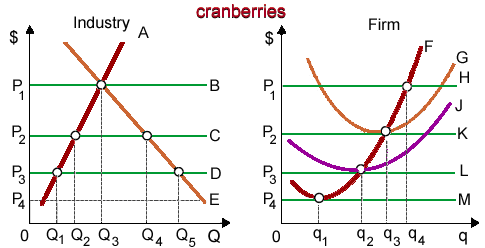
1768_demand and supply.png

Can anybody suggest me the proper explanation for given problem regarding Economics generally?

   Related Questions in Microeconomics

  • Q : Consumption of goods changes as income

    This below figure demonstrates how consumption of goods A, B, C and D changes as a family’s income changes. When income increases, the income elasticity of demand is positive although declining for: (w) good A. (x) good B 

  • Q : Moral Hazard-Equilibrium wage If

    If workers know that they are guaranteed a particular weekly wage and can simply find another job at this equilibrium wage, then some workers tend to loaf or shirk. This is an illustration of: (i) Adverse selection. (ii) Moral hazard. (iii) Demand and supply. (iv) Ine

  • Q : Traditional transfer in kind assistance

    Most traditional transfer in kind helps programs: (w) increased benefits for every dollar earned. (x) reduced benefits by $1 for every dollar earned. (y) reduced benefits by less than $1 for each dollar earned. (z) reduced benefits by more than $1 for

  • Q : Marginal tax rate on earn income The

    The marginal tax rate onto earned income in the negative income tax system demonstrated in this figure is: (1) 15 percent. (2) 20 percent. (3) 25 percent. (4) 33.3 percent. (5) 50 percent.

  • Q : Total costs incur by profit-maximizing

    Hybrid Roses is the merely florist in 60 miles of Presidio, Texas. When total fixed costs (for example, rent and utilities) are $9 per hour, that profit-maximizing monopolist will incur total costs of around: (w) $20 per hour. (x) $27

  • Q : Problem regarding Wage Discrimination I

    I have a problem in economics on Problem regarding Wage Discrimination. Please help me in the following question. The economic term applied if equally productive workers are paid various wages is: (i) Wage discrimination. (ii) Racism. (iii) Employment

  • Q : Borrower and lenders in financial

    Financial institutions like banks perform as intermediaries. They lend their savings of depositors to final borrowers, charging more interest to borrowers than they pay to depositors, who are the eventual providers of loans. How does it decrease the <

  • Q : Wages for workers and economic rent The

    The monthly check which you pay to your landlord shows: (w) interest for use of the landlord’s capital, and wages for maintenance workers, economic rent depends on the location and amount of land as well as perhaps, several economic profit (when there is any mon

  • Q : Nondiscriminating monopolists in short

    Within short run equilibrium, there nondiscriminating monopolists will: (w) charge prices greater than their marginal costs. (x) produce outputs which maximize social welfare. (y) produce where their total revenues are maximized. (z)

  • Q : Needs Standard for Income Distribution

    The needs standard for income distribution would certainly involve: (w) difficulty in the measurement of productivity. (x) an enormous bureaucracy. (y) greater incentives for production than the contribution standard. (z) economic ef