--%>

Giving wholesale price per dozen by purely competitive firm

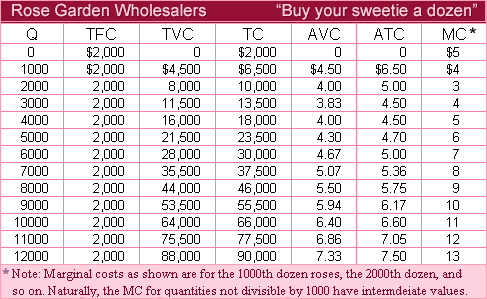
When Rose Garden Wholesalers has a typical type cost structure of rose farms within this purely competitive industry, into the long run new competitors would most likely enter the market providing the wholesale price per dozen roses exceeded as: (i) $3.00 per dozen roses. (ii) $3.83 per dozen roses. (iii) $4.00 per dozen roses. (iv) $4.30 per dozen roses. (v) $4.50 per dozen roses.
1181_Profits and Losses.png

Hey friends please give your opinion for the problem of Economics that is given above.

   Related Questions in Microeconomics

  • Q : Problem on demand for sport utility

    Can someone help me in finding out the right answer from the given options that the demand for sport utility vehicles is most probable to decline in response to main rises in: (1) Consumer’s income. (2) The number of consumers. (3) Relative prices for pickups an

  • Q : Purely competitive model for analyzing

    The purely competitive model: (w) is characteristic of many actual U.S. market structures. (x) analyzes a type of economy which is now extinct. (y) is a helpful abstraction from actuality for analyzing firms’ behavior. (z) proves which modern ca

  • Q : Problem on losing financial investments

     Can someone please help me in finding out the precise answer from the following question. Owners generally can’t lose more than their financial investments when a firm is a: (i) Proprietorship. (ii) Family business. (iii) Partnership. (iv) Corporation.

  • Q : Short Run-At least one resource is fixed

    Can someone please help me in finding out the accurate answer from the following question. In short run: (1) The quantities of all firm’s resources are variable. (2) Managers are less proficient than they are in long run. (3) At least one of the resources is fix

  • Q : Rang of income elasticities of demand

    The income elasticities of demand (μ) for items which most people consider as luxuries would possibly be into the range: (1) – ∞ < μ < one. (2) – 1 < μ < zero. (3) μ = zero. (4) 0 < μ < 1. (5) 1 <

  • Q : Average retail price and the consumer

    Table illustrates the average retail price of milk and the Consumer Price Index from the year 1980 to 1998.

    Q : Market-period supply curve For a purely

    For a purely competitive industry a market-period supply curve would be: (i) curve A. (ii) curve B. (iii) curve C. (iv) curve D. (v) curve E.

    Q : Change in relative price I have a

    I have a problem in economics on Change in relative price. Please help me in the following question. The Substitution takes place all along a demand curve when there is a: (1) Rapid shortage of a required product. (2) Increase in the common price level. (3) Change in

  • Q : Shortages and surpluses in the market A

    A shortage as in below graph, during this market for papayas would match up to line: (1) ab. (2) cd. (3) ac. (4) bd. (5) ae. 1802_example</span></p>
                                        </div>
                                        <!-- /comment-box -->
                                    </li>
   
   </td>
	</tr><tr>
		<td>
       
      <li>
                                        <div class=

    Q : Quantity demanded and goods price The

    The law of demand defines that there is a negative relationship among: (1) A good’s price and quantity demanded. (2) Limitless demands and inadequate resources. (3) The quantities demanded and supplied. (4) People’s income and demands for