--%>

Example to illustrate non-tariff trade barriers

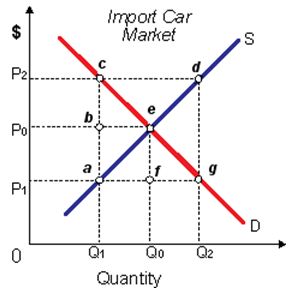
Imports and American cars are close nevertheless not ideal substitutes. When the U.S. government tried to boost American car sales through setting a price ceiling of P1 upon imported cars in that case: (w) the quantity of cars imported will fall from Q0 to Q1. (x) American car prices would rise to P2. (y) foreign car exporters would ship more luxury cars to the United States. (z) American-made car sales would rise by Q2 to Q0.
427_Trade Barriers.png

Hello guys I want your advice. Please recommend some views for above economics problems.

   Related Questions in Microeconomics

  • Q : Where is demand perfectly price

    For Pixie's cheesy fried grits demand is perfectly price inelastic at a price of: (w) P4. (x) P2. (y) 0. (z) None of the above.

    Q : Define deficient demand or deflationary

    Define deficient demand or deflationary gap: Deficient demand occur whenever AD is less than AS at the level of full employment equilibrium

  • Q : Classification of firms Can someone

    Can someone please help me in finding out the precise answer from the following question. The summation of all the firms which produce a given product is categorized as: (1) Multinational. (2) An industry. (3) Cartel. (4) Monopoly. (5) Plant.

  • Q : Determine income elasticity of demand

    An income elasticity of demand for a good equivalent to two implies roughly that: (1) demand curves for the good slope upward. (2) the product is an inferior good. (3) each 1% gain in income boosts the amount sold through 2%. (4) a 20% gain in income

  • Q : Long-run purely competitive industry

    For a purely competitive industry in the long-run: (w) neither net entry nor net exit of firms will arise. (x) firms will experience significant economies of scale. (y) the typical firm’s economic profit will exceed its accounting profit. (z) th

  • Q : Technology and human knowledge in

    The procedure in which the technology and human knowledge are employed to apply energy to convert materials to make the materials more precious is known as: (1) Social overhead. (2) Capitalism. (3) Production. (4) Construction. (5) Profit-seeking.

    Q : Ceteris Paribus assumption The ceteris

    The ceteris paribus (all as well constant) assumption is most obviously implicit in the statement of a tailor who states that, “We will vend more suits in the month of May of 2008: (i) Than we sold in the month of May 2003. (ii) Than we sold in

  • Q : High fashion at low prices-too good a

    The influence of high street chains selling very limited editions of designer clothes at much below equilibrium prices.

  • Q : Idea of low price elasticity of demand

    Purposes for the very low price elasticity of demand for salt do not comprise the fact such that this: (w) has few good substitutes. (x) is currently relatively low priced. (y) absorbs only small percentages of most household budgets. (z) is sodium ch

  • Q : Negatively-sloped demand curve for

    A firm which cannot price discriminate although which faces a negatively-sloped demand curve for output: (1) has a marginal revenue curve which is always below which demand curve. (2) will never knowingly produce at a level of output where the price e