--%>

Elasticity of supply of labor by changing in wage rate

If the wage rate increases from $10 per hour to $25 per hour, then the elasticity of the supply of labor from this worker is roughly: (1) zero. (2) 7/15. (3) one. (4) minus 8/15.
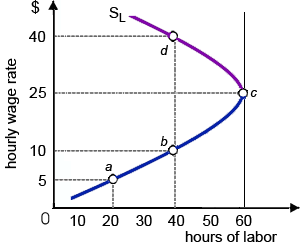
349_Problem on Supply of Labor.png

Hey friends please give your opinion for the problem of Economics that is given above.

   Related Questions in Managerial Economics

  • Q : Illustrates definition and meaning of

    Illustrates the definition and meaning of managerial economics?

  • Q : Explain the meaning of price Explain

    Explain the meaning of price.

  • Q : Perfectly supply of labor in

    The supply of labor within a perfectly competitive market is: (w) an upward sloping curve. (x) a horizontal line. (y) above the MRC. (z) below the MRC. Can someone explain/help me with best solutio

  • Q : Negatively sloped over wage ranges The

    The supply curve of the labor is negatively sloped over wage ranges where the: (1) the demand for leisure rises along with income. (2) leisure is an inferior good. (3) people offer more hours of labor at higher wages. (4) some people

  • Q : Minimum supply to specified amounts of

    If the owner of a resource is paid in excess of the minimum needed to supply specified amounts of the resource, in that case the owner is the beneficiary of: (1) economic rents. (2) wage premiums. (3) excess profits. (4) surplus values. (5) capitaliza

  • Q : Determine loss in curve of profit or

    As is given figure below. Assume that the prevailing price is P1 and the firm is now producing its loss-minimizing quantity. Determine the area which shows the loss: w) P2deP1. x) P3cbP1. y) P3caP0

  • Q : External factors in governing prices

    What are the external factors in governing prices?

  • Q : Define the difference between

    Define the difference between accounting and economic cost.

  • Q : Describe the term trend projection

    Describe the term trend projection.

  • Q : Labor Force Participation In the United

    In the United States throughout the past 70 years or therefore, the: (1) amount of human capital per worker has fallen. (2) labor force participation rate of women has risen. (3) supply of labor has consistently grown faster than the demand. (4) real rates of return f