--%>

Domestic production possibilities curve

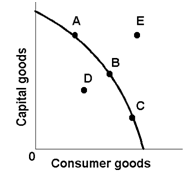
Refer to the following domestic production possibilities curve for Karalex. The gain to Karalex from specialization and international trade is represented by a move from: 1) A to B. 2) C to A. 3) C to D. 4) B to E.
814_hj.png

Help me to get through this problem

   Related Questions in Microeconomics

  • Q : Occurrence of equilibrium in the

    Long-run equilibrium occurs while: (w) MR = MC > P (x) P = MC = MR = ATC (y) ATC > P = MC(z) P = MR = MC = AFC I need a good answer on the topic of Economics problems. Please give me yo

  • Q : Problem on wage discrimination Firms

    Firms which discourage the workers from discussing their salaries or wages are most likely engaged in the policies of: (i) Respect for the worker’s privacy. (ii) Monopolistic exploitation. (iii) Perfect competition. (iv) Cooperation rather than competition. (v)

  • Q : External firms enter the industry When

    When most firms in a monopolistically competitive industry currently realize economic profits: (w) a natural monopoly will eventually emerge. (x) external firms will enter the industry. (y) long run accounting profits must be zero. (z

  • Q : Average revenue and marginal revenue

    In spite of of the amount sold, price equals for a price-taker firm on both average: (i) revenue and marginal revenue. (ii) variable cost and marginal cost. (iii) fixed cost and average variable cost. (iv) total cost and marginal revenue.

  • Q : Spread of wage information The

    The Employers frequently discourage the spread of wage information since they fear that: (i) Lower salaried workers might use the information to negotiate the raises. (ii) Firms honor employee’s privacy only when secrecy is reciprocated. (iii) Unions try to orga

  • Q : Maximum possible profitable firm A firm

    A firm possessing important market power may suffer by managerial slack [X-inefficiency] and unessential high costs, which implies that, the firm: (i) is likely to be absorbed through a predatory rival. (ii) realizes less than the max

  • Q : Problem on Monopolistic Competition

    When fifty fast-food restaurants belonging to fourteen various chains are strung along an eight mile stretch of highway, it is an illustration of: (1) a primitive cartel. (2) pure competition. (3) monopolistic competition. (4) an oligopoly.

    Q : International demand or supply affected

    Sixty Chinese manufacturers have started producing generic staplers. Since each factory is very small to noticeably influence the international demand or supply for staplers, every firm is: (1) a cartelized seller. (2) a price taker. (3) a primary goo

  • Q : Examples of Labor

    The contracts needing employment after some worker’s jobs have been made obsolete through automation are illustrations of: (i) Blacklisting. (ii) Labor-reducing protectionism. (iii) Check-off provisions. (iv) Yellow dog contracts. (v) Feather-bedding.

  • Q : Total revenue minus total cost An

    An unregulated monopoly which does not price discriminate maximizes profit at the output level which maximizes: (w) P minus marginal costs [MC]. (x) total revenue minus total cost. (y) marginal revenue [MR] minus marginal costs [MC]. (z) price minus a