--%>

Average retail price and Consumer Price Index table question

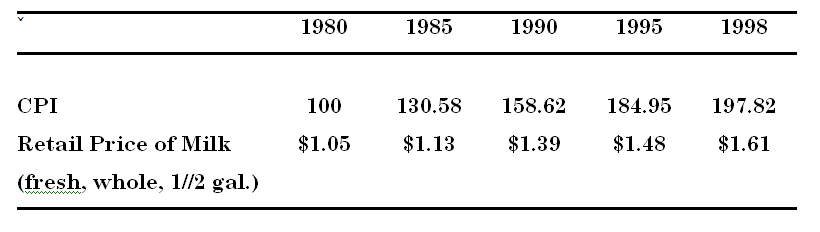
Answer the question based on given table of average retail price of milk and the Consumer Price Index from the year 1980 to 1998.
420_Average retail price and the consumer Price Index.png

Determine percentage change in the real price (1990 dollars) from the year 1990 to 1995? Compare this with your answer in (b). What do you notice? Describe.
Percentage change in real price from the year 1990 to 1995 =1.26-1.39/1.39 . This answer is approximately identical (except for rounding error) to the answer attain for part b. It does not matter which year is selected as the base year.


   Related Questions in Microeconomics

  • Q : Economic Efficiency in Financial

    Financial institutions make possible economic efficiency primarily since: (w) laissez faire markets handle asymmetric information poorly. (x) corporate ownership must be stabilized. (y) they channel funds from agents along with surplu

  • Q : Increasing-cost industries average

    Within increasing-cost industries average there are: (w) production costs fall as output increases. (x) production costs rise as the number of firms in the industry grows. (y) production costs rise when the number of firms into the industry falls. (z)

  • Q : Best society according to Utilitarianism

    Utilitarianism states that the best society is one which gives the: (1) Essential goods to meet people’s requirements. (2) Biggest happiness for the greatest number of people. (3) Precise measurement of disutility and utility. (4) Highest guaran

  • Q : Substitution of goods for buyers Can

    Can someone help me in finding out the right answer from the given options. The market demand curves slope downward as: (i) Supply curves are positively sloped. (ii) Each and every buyer has similar preferences and incomes. (iii) Buyers replace towards goods as their

  • Q : Relationship between APP-MPP If APP is

    If APP is at its maximum, then what is the relationship among MPP and APP? Answer: MPP = APP

  • Q : Elimination of discrimination In the

    In the following diagram, the elimination of discrimination is best depicted by: 1) a move from C to E. 2) an inward shift of the production possibilities curve. 3) a move from A to D. 4) a move from E to C.

    Q : Close down a purely competitive firm in

    Within the short run, there a purely competitive firm will close down its plant(s) and manufacture nothing when: (i) this makes no pure economic profits. (ii) normal profits were unattainable. (iii) P < ATC at all output levels. (iv) accounting pro

  • Q : Positively slope of short-run market

    Within purely competitive industries: (w) short-run market supply curves are positively sloped. (x) long-run market supply curves are positively sloped. (y) short-run supply is more elastic than long-run supply. (z) economic profit exceeds accounting

  • Q : Enter an industry by barriers to entry

    Barriers to entry: (w) make this complicated or impossible for new firms to profitably enter an industry. (x) uniformly violate U.S. antitrust statutes. (y) are fundamentally technological instead of economic. (z) stimulate aggressive competition.

  • Q : Contribution standard of income

    The contribution standard of income distribution: (w) sets the least efficient incentives for production. (x) is the distribution standard most compatible along with pure capitalism. (y) minimizes individual economic freedom. (z) is very complimented