--%>

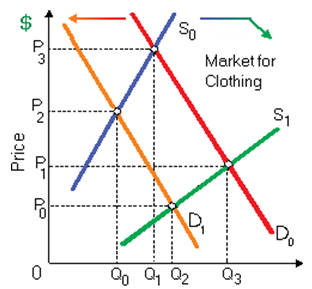
Determine the supply of clothing when demand is given

A pair of possible descriptions for simultaneous transfers of the demand for clothing from D0 to D1 while the supply of clothing transferred from S0 to S1 could be which: (1) unexpectedly cold and frequent blizzards caused Minnesotans to buy more woolens, when an epidemic which made sheep go bald drove down the price of wool. (2) global warming caused the silkworm population to explode and mature exceptionally quickly, and fashionistas persuaded lounge lizards to wear only last-year's vintage denim. (3) college fraternities needed their pledges to wear three-piece suits 8 hrs daily and to donate all T-shirts to the Salvation Army. (4) deforestation decimated the population of wild acrylics within a single season when surfers began wearing head-to-toe scuba suits while cancer via sun damage became rampant. (5) textile employees responded to stiff tariffs on imported apparel along with a nationwide strike.
1760_Institutions.png

   Related Questions in Public Economics

  • Q : Value of the best foregone alternative

    The value of the best foregone alternative explains: (w) opportunity costs. (x) monetary costs. (y) irrational behavior through a consumer. (z) retail price margins over production costs. How can I solve my above e

  • Q : Why are Land Land, labor, and capital

    Land, labor, and capital are all scarce since: (w) human wants are restricted. (x) less is obtainable than people want. (y) each productive resource needs a monetary return for its use. (z) once employed they cannot be used again.

    Q : Fee-simple private property rights I

    I have a problem in economics on Resources and Products Flow Model. Please help me in the following question. “Fee-simple” private property rights permit you to: (1) Shoot trespassers who are on your land with no permission. (2) Refuse to

  • Q : Existence of economic inefficiency

    Economic inefficiency exists while there is: (1) A society suffers through economic inequity. (2) No approach for anyone to gain unless someone else loses. (3) Additional output could be generated at lower cost. (4) Maximum net benefits are acquired f

  • Q : Economic goals of all economic activity

    Adam Smith believed about the ultimate suitable objective of all economic activity is to maximizing: (w) wealth and power of the national government. (x) satisfaction of individuals by giving people along with the goods they want. (y) employment oppor

  • Q : Decisions and owns resources The

    The Economic systems are categorized mainly according to: (1) Who makes decisions and who owns the resources. (2) Which political parties are in the power. (3) The extent of economic growth. (4) How efficiently resources are employed.

    Q : Fundamental categories for economic

    The four fundamental categories for economic resources are: (w) matter, energy, technology and information. (x) wages, rent, interest and profits. (y) land, labor, capital and entrepreneurship. (z) machinery, energy, workers and government.

  • Q : Consequence of the increased

    People would be least probable to be happier like a consequence of the increased accessibility of: (1) free goods. (2) economic resources. (3) superior technologies. (4) economic goods. (5) economic bads. Hello guys I want your adv

  • Q : Capitalism as a decentralized decision

    The idea that a virtue of the capitalism is its decentralized decision making appeared when: (i) Social philosophers looked for the alternatives to feudal kings as the economic regulators. (ii) Russian imperialism fostered anti-communist sentiment fol

  • Q : Determine the requirements of

    Within broad economic terms "efficiency" needs: (w) an upward move within the production curve. (x) full employment. (y) it being not possible to make someone better off without creating someone else worse off. (z) producing cars with low gas consumption.