--%>

Contestable Markets

When consumers ultimately cannot distinguish one roasted chicken dinner from other, when roasted chicken dinners are produced within a constant cost industry, and when no barriers to entry or exit exist, in that case the long-run equilibrium price per generic chicken dinner will be approximately: (1) $12. (2) $10. (3) $8. (4) $6. (5) $3.
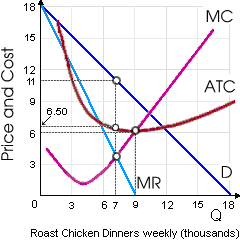
2435_Market Power and Short Run Economic Profit.png

How can I solve my Economics problem? Please suggest me the correct answer.

   Related Questions in Microeconomics

  • Q : Purely competitive industry in the long

    For a purely competitive industry in the long run: (i) several firms exit therefore others may earn more than normal profits. (ii) established firms reap higher profits than newer firms. (iii) all resources are fixed for the industry as an entire. (iv

  • Q : Purchasing power of a consumers income

    The modification in purchases which results since changes in relative prices modify the purchasing power of a consumer's income is termed as: (i) Adjustment margin. (ii) Income effect. (iii) Demonstration effect. (iv) Transfer pattern. (v) Replacement

  • Q : Total costs from maximizes profit If

    If this firm maximizes its profit as in given graph, then its total costs equal: (w) $75,000 per month. (x) $90,000 per month. (y) $15,000 per month. (z) $105,000 per month.

    Q : Monopolistic competition and product

    The demand curve facing a monopolistically competitive firm might shift rightward when this: (w) increases wages to workers. (x) experiences a decline in costs. (y) advertises successfully. (z) responds strategically to competitors&rs

  • Q : Shortages and surpluses in the market A

    A shortage as in below graph, during this market for papayas would match up to line: (1) ab. (2) cd. (3) ac. (4) bd. (5) ae. 1802_example</span></p>
                                        </div>
                                        <!-- /comment-box -->
                                    </li>
   
   </td>
	</tr><tr>
		<td>
       
      <li>
                                        <div class=

    Q : Relatively price inelasticity of demand

    When cuts into the price of cowboy hats drive down total revenues to hat makers, in that case demand: (1) relatively price elastic. (2) relatively price inelastic. (3) unitarily price elastic. (4) infinitely price elastic. (5) zero pr

  • Q : Problem on Monopsony Power The firm

    The firm probable to encompass significant monopsony power in its labor market would be: (1) Big cotton farm in the Texas hiring migrant workers. (2) Textile producer in the Hong Kong hiring factory workers. (3) Janitorial service firm in London hiring the maintenance

  • Q : Price Elasticity-Income Elasticity and

    When both population and per capita income grow across time, in that case your income will tend to be most erratic but the goods you sell are: (1) both income inelastic and price inelastic within demand. (2) a large part of classical

  • Q : Law of comparative benefits Can someone

    Can someone please help me in determining the right answer from the following question. The law of comparative benefit exhibits: (a) Why trade with a country in which salaries are low is not fair. (b) How countries try to use each other via trade. (c)

  • Q : Equilibrium in long-run purely

    When a purely competitive industry is into long-run equilibrium: (i) firms try to maximize profit. (ii) P = ATC. (c) P = MC. (iii) economic profit is zero. (iv) All of the above. Can someone explai