--%>

Supply curve for price elasticity of supply

Suppose that all these demonstrated curves are infinitely long straight lines. So, a supply curve for that price elasticity of supply is constant for each possible price and quantity is: (i) supply curve S2. (ii) supply curve S3. (iii) supply curve S5. (iv) none of the above.
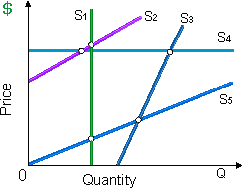
1234_Price Elasticity of Supply1.png

Can anybody suggest me the proper explanation for given problem regarding Economics generally?

   Related Questions in Microeconomics

  • Q : Emerging by price discrimination

    Oligopolies are least expected to emerge due to: (1) economies of scale. (2) price discrimination. (3) strategic barriers to entry. (4) mergers. (5) legal barriers to entry. Can anybody suggest me the proper explan

  • Q : Competition and Social Welfare The

    The purely competitive firm in an output market which hires from a purely competitive labor market will use labor at the point where VMP = W as the firm: (i) Operates in the society's best interest. (ii) Wants to be pretty fair to workers. (iii) Is eg

  • Q : Competitive Profit Maximization Can

    Can someone please help me in finding out the accurate answer from the following question. The profit-maximizing competitive firm hiring from the competitive labor market will be in balance or equilibrium where: (i) w = MRC. (ii) MPP = MRC. (iii) VMP = MPP. (iv) VMP =

  • Q : Managerial slack or X-inefficiency

    X-inefficiency (also termed as managerial slack): (1) tends to drive up fixed costs. (2) commonly results from firms not being hard pressed through competitors. (3) can absorb much of a monopoly’s potential profit. (4) is a prob

  • Q : Perfectly demand elasticity On a

    On a horizontal demand curve, there: (w) demand is perfectly elastic. (x) demand is perfectly inelastic. (y) the elasticity of demand varies. (z) demand is unitarily elastic. Can someone explain/help me with best s

  • Q : Interest-rate cost A profit-maximizing

    A profit-maximizing firm must not undertake a R&D project for which the: 1) Expected rate of return exceeds its interest-rate cost of funds. 2) interest-rate cost of funds exceeds the expected rate of return. 3) expected returns are in the distant future. 4) the e

  • Q : Problem of tax on a good I have a

    I have a problem in economics on Problem of tax on a good. Please help me in the following question. The tax on a good tends to form: (1) A wedge between the price buyers pay and the price sellers collect. (2) Rises in supply from the perspectives of buyers. (3) More

  • Q : Prevent operating in long run by

    A monopolist will prevent operating within the long run unless its economic profit is: (i) zero. (ii) positive. (iii) greater than accounting profit. (iv) zero or greater. (v) zero or less. I need a good answer on

  • Q : Defined Welfare Recipients By

    By description, a family of four receives welfare when it: (1) pays a smaller share of taxes than its share of benefits from government. (2) lives below the poverty line. (3) includes a student attending college on an academic scholar

  • Q : Multimarket Monopoly A monopolist

    A monopolist operates in two separated markets. The inverse demand functions ofthose markets are given by      and      where   arethe quantities supplied to these markets, respectively. The total cost function facedby the monopolist is &nbs