--%>

Competitive Prices for selling

This purely-competitive producer’s generic bricks presently sell for: (i) $60 per thousand. (ii) $70 per thousand. (iii) $80 per thousand. (iv) $90 per thousand. (v) $100 per thousand.
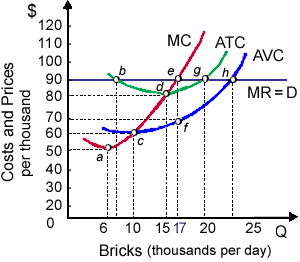
184_Profit Maximization1.png

Hey friends please give your opinion for the problem of Economics that is given above.

   Related Questions in Microeconomics

  • Q : Public Goods and Service Why does a

    Why does a good or service become a public good or service?

  • Q : Problem on substitution effect The

    The substitution effect is the modification in purchases of a good which outcome from a change only in: (1) Tastes and preferences. (2) Its associative price. (3) Real national income. (4) The wealth of consumer. P

  • Q : Tax burden distribution of relatively

    Demands for alcoholic and tobacco beverages tend to be relatively price inelastic and income inelastic. There per unit “sin taxes” upon these products will share out the tax burden: (i) proportionally among high-income and

  • Q : Signals of economic profits to

    Economic profits are: (1) signals which, for efficiency, more resources must be moved into an industry. (2) rewards to successful innovators. (3) capitalized as wealth when they can be expected over time. (4) a residual to a firm's owners for bearing

  • Q : Perfectly price discrimination

    Babble-On holds world-extensive patents for software which translates any of 314 spoken languages within text, along with automatic audio and text translations within any of the other three-hundred-thirteen languages. This figure illustrates that Babble-On as: (1) is

  • Q : Profit Maximization in Labor Markets

    Can someone help me in finding out the right answer from the given options. All the profit maximizing organizations employ labor up to the point where: (1) MR   MC is maximized. (2) VMP = MFC. (3) VMP = MRP. (4) MRP = MFC. (5) VMP = w.

  • Q : Problem on decline in demand function

    In the month of January, Disney World in Florida cut its ticket prices into half and starts letting all kids beneath age five without charge. The economic forecaster might reasonably expect: (1) A decline in demand for the tickets to Disney Land in California. (2) A r

  • Q : Output of profit-maximizing monopolist

    Hybrid Roses is the merely florist in 60 miles of Presidio, Texas. When total fixed costs (for example, rent and utilities) are $9 per hour, such profit-maximizing monopolist will generate an output of: (1) two dozen roses per hour. (

  • Q : Unite to form cartels and share

    Oligopolies which unite to form cartels and share monopoly profits give an illustration of: (i) collusive behavior. (ii) territorial imperatives. (iii) mergers and acquisitions. (iv) non-collusive strategy. (v) corporate raiding.

  • Q : Monopolistic competition in long run

    When this firm initially had important market power along with potential long-run economic profit, a likely cause of the firm finally being in a stable equilibrium of an $18 price and output of 5,000 units every day would be:  (1