--%>

Burden of tax reduce on suppliers of the good

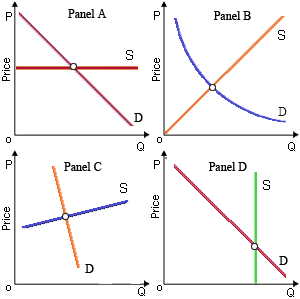
Most of the burden of an excise (i.e., per unit) tax would be borne through consumers of the taxed good, although some of the tax burden would reduce on suppliers of the good demonstrated in: (w) Panel A. (x) Panel B. (y) Panel C. (z) Panel D.
208_Price Elasticities and Tax Burdens.png

Can someone explain/help me with best solution about problem of Economics...

   Related Questions in Microeconomics

  • Q : On which point demand appears to be

    On this demonstrated figure of demand curve for DVD games, demand appears to be approximately unitarily elastic at: (w) Q = O, P = $50. (x) Q = 10, P = $O. (y) Q = 5, P = $25. (z) No point on the demand curve.

    Q : Effective price discrimination

    Effective price discrimination does NOT need a firm to: (w) segment the market into groups along with various demand elasticities.  (x) be a monopoly. (y) prevent trading among customers who are charged different prices. (z) possess some market p

  • Q : Output level at demand in a

    Babble-On maintains world-wide patents for software which translates any of 314 spoken languages within text, with automatic audio and text translations in any of the other three-hundred-thirteen languages. Babble-On will never intentionally produce as well as sell vo

  • Q : Law of demand in Ceteris Paribus Can

    Can someone help me in finding out the right answer from the given options. The law of demand supposes that the income and tastes of the consumers are: (i) Strong determinants of the prices. (ii) Causes of movements all along the demand curve. (iii) C

  • Q : Characteristic of pure competition A

    A purely competitive firm: (w) is a price taker. (x) is a price maker. (y) is a large part of the industry. (z) sells a differentiated product. Hello guys I want your advice. Please recommend some views for above <

  • Q : Relatively elastic of demand in

    While a price hike yields a decline within total revenue, in that case the demand faced through the producing firm: (w) relatively elastic. (x) relatively inelastic. (y) unitarily elastic. (z) inferior. Can anybody

  • Q : Valuable human capital The maximum

    The maximum valuable human capital on the given list would be possessed by the person who: (1) Inherited a big deal of money. (2) Invested big sums on stock market. (3) Had an advanced degree in the music education. (4) Specialized as the medical doctor.

  • Q : Adverse Selection as a classifiable

    Which of the given below conditions is most evidently classifiable as the adverse selection? (i) The company manufactures a miracle weight loss solution guarantee enduring weight loss, however in realism the solution only rids surplus water weight for

  • Q : Current consumption over future

    When households’ start increasingly to prefer current consumption over future consumption, in that case the: (w) interest rate rises. (x) interest rate falls. (y) present value of future income rises. (z) equilibrium rate of investment within hu

  • Q : Economic profits by potential customers

    When you lease a building for five years and rapidly achieve economic profits since it is located conveniently for potential customers: (1) you could capitalize some of these pure profits when you sold your business along with a sublease at the ending