--%>

Break-even level of income under negative income tax

For a family of four the break-even level of income under the negative income tax system demonstrated in this figure is: (1) $15,000 per year. (2) $30,000 per year. (3) $45,000 per year. (4) $60,000 per year. (5) $75,000 per year.
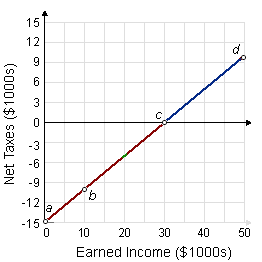
230_Negative Income Tax Problem.png

Hey friends please give your opinion for the problem of Economics that is given above.

   Related Questions in Microeconomics

  • Q : Labor Unions and Aggregate salary Income

    The least probable outcome when unions succeed in increasing their member’s salaries is that: (1) Wages in non-union sectors will drop. (2) Employment will produce in non-union sectors. (3) Barriers will be building up to limit the entry to unions. (4) Labor's s

  • Q : Externalities or public goods in purely

    A purely competitive economy along with no externalities or public goods tends to be efficient since: (1) firms try to act socially responsible. (2) government planners specify the best allocation. (3) all prices approximate marginal social benefits a

  • Q : Marginal tax rate on earn income The

    The marginal tax rate onto earned income in the negative income tax system demonstrated in this figure is: (1) 15 percent. (2) 20 percent. (3) 25 percent. (4) 33.3 percent. (5) 50 percent.

  • Q : Legal doctrine in Laws and Regulations

    Whenever goods are non-standardized and rarely purchased by an individual, an assumption that the sellers will contain superior knowledge of the product characteristics is an argument for applying the authorized doctrine of: (1) Caveat emptor. (2) Nolo contendere. (3)

  • Q : Propensity to consume Propensity to

    Propensity to consume: This exhibits the level of consumption at various levels of income in the economy.

  • Q : Price consistent with profit-maximizing

    HoloIMAGine has patented a holographic technology which creates 3-D photography obtainable to consumers. So the price consistent along with HoloIMAGine's profit-maximizing output would be of: (1) price P1. (2) price P2. (3) price

  • Q : Competitive Prices for selling This

    This purely-competitive producer’s generic bricks presently sell for: (i) $60 per thousand. (ii) $70 per thousand. (iii) $80 per thousand. (iv) $90 per thousand. (v) $100 per thousand.

    Q : Market Power-Demand for Labor I have a

    I have a problem in economics on Market Power and the Demand for Labor. Please help me in the given question. The lack of competition in product market outcomes in: (1) Less labor being hired than when the markets were competitive. (2) Many labor bein

  • Q : Excess demand for commodity When do we

    When do we state that there is an excess demand for a commodity in the market?

  • Q : Hicks Model of Bargaining The John

    The John Hick’s bargaining model recommends that the union wage demands and a firm's wage provide: (i) Might be so distinct that the management hires scabs. (ii) Are non-negotiable in the competitive environment. (iii) Become identical as the du