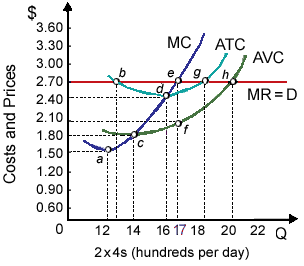
Average variable costs per generic of pure competitor
Average variable costs per generic 2×4 of this pure competitor’s equal roughly: (w) $0.20 (20¢ per 2×4). (x) $1.00 per 2×4. (y) $1.70 per 2×4. (z) $2.10 per 2×4. Can someone explain/help me with best solution about problem of Economics...
Average variable costs per generic 2×4 of this pure competitor’s equal roughly: (w) $0.20 (20¢ per 2×4). (x) $1.00 per 2×4. (y) $1.70 per 2×4. (z) $2.10 per 2×4.
Can someone explain/help me with best solution about problem of Economics...
This alters in the supply- and demand-curves for textbooks could not have resulted from a change in: (w) taxes. (x) relative prices for text books. (y) expectations about future prices. (z) prices for related goods.
I have a problem in economics on Production Possibilities Frontiers. Please help me in determining the right answer from the following question. The economy’s capacity to generate/make is NOT limited by the: (i) Amount of resources accessible. (
A purely-competitive, short-run equilibrium does NOT need which each firm: (w) produces where MC = MR = P > min(AVC). (x) experiences no excess demand or excess supply. (y) earns only zero economic profit. (z) adjust output hence m
What does AFC curve appear like? Why does it appear so?
The Siberian Software vends custom programs to big multinationals. Its programs are coded in the remote region. In equilibrium, the Siberian faces a marginal factor cost for the programmers of roughly: (1) $21 per hour. (2) $24 per hour. (3) $12 per hour. (4) $18 per
Equilibrium interest rates change among various financial instruments due to differences in all of the given EXCEPT: (w) default risk. (x) time to maturity. (y) liquidity. (z) the solvency of the lender. Hey friend
What determines the intersection of demand and supply curves?
Can someone help me in finding out the right answer from the given options. The employer with monopsony power exploits the labor if it pays a wage: (i) At a bare subsistence level. (ii) That stabilizes worker population. (iii) Less
Can someone help me in finding out the right answer from the given options. The Economists state that a market is cleared when the price is in such a manner that: (i) Each and every good produced is sold. (ii) Quantity and Price are equal. (iii) Surplus demand surpass
When the demand curve for a firm’s product is negatively sloped into the short run, in that case the firm: (i) operates in a purely or perfectly competitive market. (ii) experiences economies of scale in its production function. (iii) will face
18,76,764
1928509 Asked
3,689
Active Tutors
1456433
Questions Answered
Start Excelling in your courses, Ask an Expert and get answers for your homework and assignments!!