--%>

Determine average production cost by an example

When Robomatic Corporation maximizes profit in its production of RoboMaids, its average production cost per robot will be roughly: (1) $3,000 per robot. (2) $5,000 per robot. (3) $7,000 per robot. (4) $9,000 per robot. (5) $11,000 per robot.
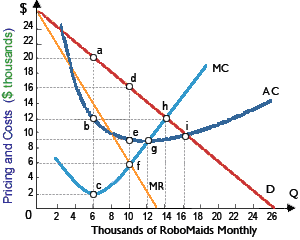
1002_Elasticity and profit.png

Hello guys I want your advice. Please recommend some views for above Economics problems.

   Related Questions in Microeconomics

  • Q : Zxcvbnm

    dssfghjkgfdsaSDFGHJKHGFDSASDFGHJK SDFGHJKLHGFDSADFGHJKHGFDSFG DFGHJKHGFDSFGHJHGSDFGHJ

  • Q : Level of guaranteed transfer payments

    For identical level of guaranteed transfer payments, the earn income and incentive to work is probable to be: (w) greater with a negative income tax than with transfers in kind. (x) greater with transfers in kind than

  • Q : Monopsonist problem I have a problem in

    I have a problem in economics on Resources and Products Flow Model. Please help me in the following question. The firm which is the sole buyer of a specific good or resource is the: (i) Monopsonist. (ii) Conglomerate. (iii) Price discriminator. (iv) P

  • Q : Problem regarding to trade barriers for

    When the import market was within equilibrium before the Japanese government began subsidizing all autos exported by the amount dg, in that case U.S. car buyers would be: (w) pay P2 for a car previouslszy priced at P0. (x) suffer Q0 to

  • Q : Bilateral Monopoly model problem Can

    Can someone please help me in finding out the accurate answer from the following question. The bilateral monopoly model is: (i) Among the most modern models of the union bargaining. (ii) Very helpful in describing specific labor agreements. (iii) The theory of dynamic

  • Q : Under negative income tax the net income

    Under the negative income tax system demonstrated in this figure, where a family of four all along with earned income of $60,000 yearly would have a net [after-tax] income of: (1) $37,500 per year. (2) $42,500 per year. (3) $50,000 per year. (4) $55,0

  • Q : Substitution effects resulting from

    The Law of Demand mainly relies heavily on the: (1) Buying power consequences of relative price modifications. (2) Substitution effect resultant from the relative price changes. (3) Increase in opportunity costs as income is worn out. (4) Principle of the non satiety.

  • Q : Price elasticity of supply computations

    At a $2 price per can, there quantity of applesauce supplied per day is 1000 cases; and at $4, the quantity supplied is 3000 cases per day. Therefore price elasticity of supply is: (i) 2/3. (ii) 1/3.(iii) 3/2. (iv) 1/4.

    Q : Problem on Elasticity formula Whenever

    Whenever the price of plastic moose heads increase from $5 to $7, monthly sales fall from 2000 to 1000 units. By using the arc elasticity formula, the price elasticity of demand will be: (i) 3.0. (ii) 1/3. (iii) 2.0. (iv) 2.5.

    Q : Unitarily elasticity in supply curve At

    At point b, in demonstrated figure the supply curve into this graph is: (w) perfectly elastic. (x) elastic, but not perfectly that why. (y) unitarily elastic. (z) inelastic.

    Discover Q & A

    Leading Solution Library
    Avail More Than 1455962 Solved problems, classrooms assignments, textbook's solutions, for quick Downloads
    No hassle, Instant Access
    Start Discovering

    18,76,764

    1933678
    Asked

    3,689

    Active Tutors

    1455962

    Questions
    Answered

    Start Excelling in your courses, Ask an Expert and get answers for your homework and assignments!!

    Submit Assignment

    ©TutorsGlobe All rights reserved 2022-2023.