How to Convert Confusing Study Topics Into Partner Reviews That Stick
A chapter often feels clear while you are reading it, then blanks when you try to explain it without notes. Re-reading and highlighting can create recognition without proving that you can retrieve the claim, connect cause to effect, or separate similar ideas. Force those checks before the exam.
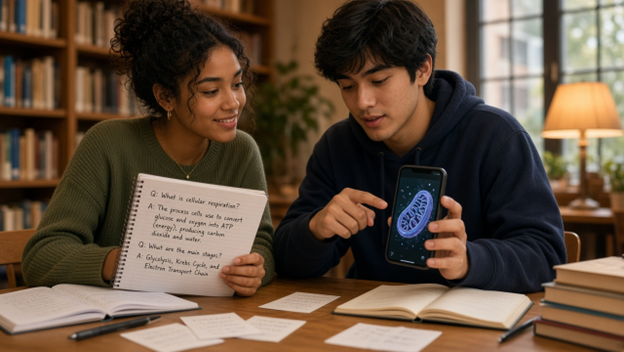
One practical method is a short partner review built on contrast: one speaker raises a question, misconception or incomplete step; the other supplies the missing link. You can practise this aloud with a study partner. If you later want a short visual version, an ai rap video generator can turn one or two photos and a tightly defined topic into a brief lip-synced performance. Decide what must be remembered first; packaging comes after.
Narrow the Target, Then Assign Contrast
Before writing lines, reduce the unit to one checkable outcome: "Without notes, I should be able to explain ___." "Understand mitosis" is too wide. "Explain why DNA replication must finish before chromosomes separate" can be tested in under a minute.
Keep four pieces only: the claim, the cue that should trigger it, the link between steps, and the trap students usually fall into. If you cannot state those aloud in thirty seconds with the book closed, return to the source.
Give the two voices different jobs. Use productive contrast:
- Question → Answer — A asks what changes; B supplies the mechanism.
- Misconception → Correction — A states a believable error; B repairs it.
- Step → Consequence — A describes an event; B states what follows and why.
A weak chemistry exchange lists definitions. A stronger one creates a decision: "If a catalyst lowers activation energy, do the products change?" "No—it speeds the path to the same equilibrium."
Compress, Package Optionally, Then Test Recall
Rewrite as short lines that keep cause and effect. Draft in plain prose, one idea per line, then trim filler while keeping technical terms. Use a simple skeleton: cue, claim, trap, correction, brief example, lasting rule. Cut any line that does not serve the original target.
Creative packaging is optional. Spoken practice or flashcards already complete the method. If you want a short generated clip, prepare one clear front-facing photo—or two for contrasting roles—and a narrow topic line. On Hookai, upload the photo or photos, choose a theme or scene, and produce a native lip-synced clip with an original beat and bars. Check that the claim, cause–effect link and terms stayed accurate. If meaning drifts, simplify and regenerate, or keep the paper script.
Then remove the support. After one rehearsal, answer the target with notes and video closed. Check three levels: recall the rule, explain why it holds, and transfer it to a new example. Fix the weak piece and retest rather than replaying the clip.
Keep the sequence, not the medium: one testable target, contrasting roles, compressed lines, optional packaging, and a recall check without supports. If you add a rap video ai package later, keep it after the academic structure is solid. End by asking what you can still explain alone.