How to Turn Difficult Study Topics Into Memorable Two-Person Review Videos
A difficult topic often feels manageable while you are reading it and unexpectedly confusing when you try to explain it without notes. That gap matters. Highlighting a chapter, copying definitions, or replaying a lecture can create familiarity without showing whether you can identify the main idea, connect causes with effects, or distinguish two concepts that look similar. A useful review activity should therefore force you to retrieve the idea, reorganize it, and explain it in your own words.
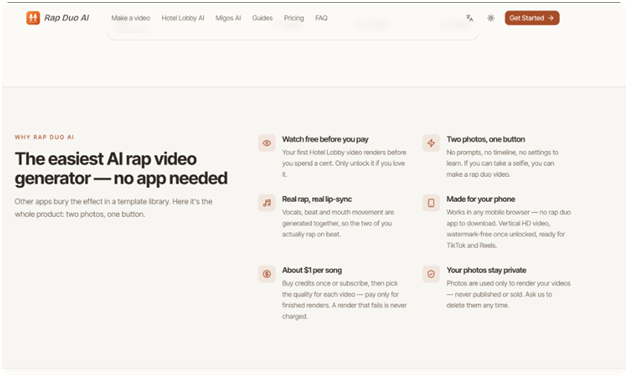
One practical way to create that pressure is to turn a topic into a short two-person exchange. Instead of squeezing an entire chapter into a summary, assign each speaker a job: one introduces a question, misconception, or problem, while the other answers and adds the missing reasoning. Simple scripts already work for this exercise, but students who want to experiment with a visual performance can use Rap Duo AI as one possible way to turn two photos and a chosen topic into a short rap-style exchange. The important part comes before generation: deciding what deserves to be remembered, how the ideas connect, and how you will check the final explanation.

Reduce the Topic Before Writing Anything
A review video becomes ineffective when it tries to reproduce an entire lesson. Before writing dialogue, reduce the material to one learning target that can be checked afterward.
Start by finishing this sentence:
"After watching this review, I should be able to explain ___ without looking at my notes."
"Understand photosynthesis" is too broad. "Explain why light-dependent reactions are needed before the Calvin cycle" is much easier to test. Likewise, "review supply and demand" is weaker than "explain what happens to equilibrium price when demand increases while supply stays constant."
Once the target is clear, extract only four pieces of information:
? Core idea: the principle the learner must remember.
? Trigger: the question, condition, or problem that activates that idea.
? Reasoning link: why one step leads to the next.
? Confusion point: the mistake a student is most likely to make.
This reduction prevents an important failure: creating something entertaining that contains many correct terms but never explains their relationship.
A simple diagnostic helps. Cover your source material and explain the four elements aloud in about 30 seconds. If you cannot do that, the topic is still too large or your understanding is incomplete. Return to the source before building the script.
Give Each Speaker a Clear Learning Role
With the learning target narrowed, the next step is deciding why two speakers are useful. Simply dividing one paragraph between two people adds movement, but it does not improve the structure of the explanation.
Instead, create productive contrast between the speakers. One person should introduce something the second person must resolve.
Three structures work particularly well:
1. Question → Explanation: Speaker A asks what happens or why; Speaker B explains the mechanism.
2. Mistake → Correction: Speaker A states a believable misconception; Speaker B identifies what is wrong and corrects it.
3. Step → Consequence: Speaker A describes an event; Speaker B explains what follows and why.
For example, a statistics review should not become alternating definitions:
Weak version: "The mean is an average. Standard deviation measures spread."
A more useful exchange creates a decision:
Better version: "Two classes have the same mean. Are their scores equally consistent?" "Not necessarily. Compare the standard deviation; the smaller value shows scores clustering more closely around the mean."
The second version gives the viewer something to predict before hearing the answer. That is the pattern to preserve when converting the material into a more creative format.
Convert Explanations Into Short Review Lines
Once each speaker has a role, compress the explanation without deleting its logic. Short lines are useful only when they still preserve the relationship between ideas.
Begin with a plain-language explanation rather than trying to write rhymes immediately. Aim for one idea per line. Then remove filler while keeping important academic terms intact.
For a six-line review, this structure is usually enough:
? Line 1: establish the question or situation.
? Line 2: state the first principle.
? Line 3: introduce the likely confusion.
? Line 4: correct it.
? Line 5: apply the principle to an example.
? Line 6: finish with the rule the learner should remember.
Consider opportunity cost:
"I chose the concert, so the ticket price is my opportunity cost." "Not quite-the cost is the best alternative you gave up." "So if I skipped a paid shift?" "That lost alternative is what you compare with the choice you made."
Notice that the exchange does more than repeat a definition. It tests the boundary of the concept.
After drafting, highlight every line that contains information necessary to answer the original learning target. If half the script could disappear without affecting the explanation, those lines are probably decorative rather than educational.
Turn the Script Into a Visual Review
Only after the academic structure works should you decide whether a generated video adds value. The tool should package an already understandable explanation rather than compensate for a weak one.
For a two-person version, prepare two clear, well-lit, front-facing photos, choose one narrowly defined topic, and avoid stuffing several unrelated concepts into the same generation. RapDuo's public workflow supports separate photos for two performers, allows a topic or occasion to guide the generated lyrics, and produces a lip-synced two-person rap performance. In that specific situation, Rap Duo Video AI can serve as the production step after the learning target and content boundaries have already been decided.
Do not judge the result by animation quality alone. Run a content check immediately afterward:
? Did the video state the correct core concept?
? Did it preserve the cause-and-effect relationship?
? Did any rhyme change the meaning of a technical term?
? Could someone answer the original learning target after watching it?
? Is there a catchy line that sounds correct but is actually oversimplified?
If an important definition or relationship changes, revise the input rather than memorizing the generated wording. A memorable error is still an error.
Test Recall Instead of Replaying the Video
Once the video is finished, repeated viewing can become passive very quickly. The next stage should therefore remove the support you just created.
Watch the review once, wait briefly, and then answer the original learning target without replaying it. Write the explanation or say it aloud. Afterward, compare your answer against your course material.
A useful three-level check is:
? Level 1 - Recall: Can you state the key rule without prompts?
? Level 2 - Explain: Can you describe why the rule works?
? Level 3 - Transfer: Can you apply it to a new example?
Suppose your video explains that correlation does not automatically establish causation. Repeating that sentence passes Level 1. Explaining that another variable or reversed direction may account for the association reaches Level 2. Identifying that problem in an unfamiliar research example demonstrates Level 3.
When you fail a level, revise the study material that caused the failure. Missing vocabulary suggests the key terms need clarification. Missing reasoning means the dialogue needs a stronger explanation. Failure on a new example usually means the review was too dependent on one scenario.
Build a Review Method You Can Reuse
The finished video is less important than the method used to create it. Begin with one testable learning target, reduce the source material to its essential relationships, assign contrasting roles to two speakers, and compress the explanation without removing the reasoning. If you turn that script into a creative format, check the generated wording against the original material before treating it as study content. Finally, test yourself without the video so that you can see what you actually retained.
This sequence can also work without video. The same structure can become flashcards, a spoken partner exercise, a short written dialogue, or an exam-review prompt. What makes it useful is the repeated movement from source material to explanation, explanation to application, and application to independent recall. When every review activity ends with a test of what you can explain on your own, creative study materials stop being something you merely watch and become tools for finding exactly what you still need to learn.