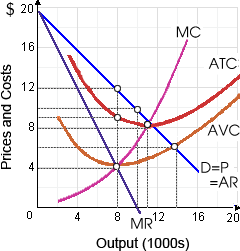
Total variable cost while maximizes economic profits
Total cost when such firm maximizes economic profits would be: (w) $72,000 per period. (x) $80,000 per period. (y) $96,000 per period. (z) $100,000 per period. Hello guys I want your advice. Please recommend some views for above Economics problems.
Total cost when such firm maximizes economic profits would be: (w) $72,000 per period. (x) $80,000 per period. (y) $96,000 per period. (z) $100,000 per period.
Hello guys I want your advice. Please recommend some views for above Economics problems.
Types of market in economy: There are two kinds of market in this economy: Factor market-for Factors of Production and Product market-for goods and Services.
If $4 is Firm B's profit-maximizing price, its: A) ATC must be $4. B) MC must be $4. C) MR must be $4. D) MC must be zero. Help me to get
The needs for pure competition are most intimately met by the market for: (i) domestic (American) steel. (ii) comic books. (iii) sugar-coated cereal within your local grocery store. (iv) stocks and bonds traded on Wall Street after they have been issu
Can someone help me in finding out the precise answer from the given options. A raise in the cost of resource inputs would lead to the: (1) Shift of the supply curve to right. (2) Shift of the supply curve to left. (3) Movement upward all along the su
Monopolists are frequently considered inefficient since they set: (w) MR = MC to maximize profits. (x) P > MSC. (y) MSR < MSC. (z) output where average revenue equals price [AR = P] as well as marginal revenue equals marginal cost [MR = MC].
The market supply curve is derived via: (i) Evaluating the net costs for each potential level of output. (ii) Inverting (or taking the mirror image of) the market demand curve. (iii) Horizontally summing up individual supply curves. (iv) Averaging the
This alters in the supply- and demand-curves for textbooks could not have resulted from a change in: (w) taxes. (x) relative prices for text books. (y) expectations about future prices. (z) prices for related goods.
The price a firm acquires from selling an extra unit of output, minus any revenue lost when price should be reduced in all other units sold, equals: (1) average revenue. (2) marginal profit. (3) mark-up price. (4) marginal revenue. (5) total revenue.<
Indifference curve: It demonstrates various combinations of two goods that provide identical level of satisfaction to the consumer.
Can someone please help me in finding out the accurate answer from the following question. Alfred Marshall classification of analytical time specified that in long run it is: (i) Not possible to differ technology and at least one resource is fixed and hence at least o
18,76,764
1954492 Asked
3,689
Active Tutors
1460873
Questions Answered
Start Excelling in your courses, Ask an Expert and get answers for your homework and assignments!!