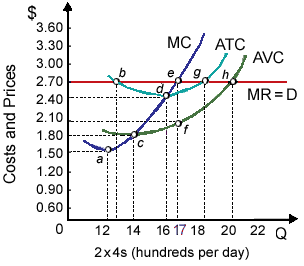
Total fixed costs of purely competitive firm
Such lumber mill has incurred total fixed costs which average approximately: (1) $300 daily. (2) $500 per day. (3) $700 Per day. (4) $900 per day (5) $1100 per day. Please choose the right answer from above...I want your suggestion for the same.
Such lumber mill has incurred total fixed costs which average approximately: (1) $300 daily. (2) $500 per day. (3) $700 Per day. (4) $900 per day (5) $1100 per day.
Please choose the right answer from above...I want your suggestion for the same.
I have a problem in economics on Problem on Agency Shop. Please help me in the following question. The Nonunion members can’t ‘free-ride’ in the states with Right-to-Work laws when a company agrees to operate a or an: (i) Closed shop
Is there competition between the producers in Canada?
This below figure demonstrates how consumption of goods A, B, C and D changes as a family’s income changes. When income increases, the income elasticity of demand is positive although declining for: (w) good A. (x) good B
Most of the U.S. capital investment is traceable to the financial investments by households, that is one way that private individuals: (i) Turn into capitalists. (ii) Save. (iii) Evade taxes. (iv) Avoid the circular flow of resources and income. Q : Problem on Monopsony I have a problem I have a problem in economics on Monopsony. Please help me in the following question. The monopsonist is a price: (1) Taker as a buyer. (2) Taker as a seller. (3) Maker as the seller. (4) Maker as the buyer. Choose
I have a problem in economics on Monopsony. Please help me in the following question. The monopsonist is a price: (1) Taker as a buyer. (2) Taker as a seller. (3) Maker as the seller. (4) Maker as the buyer. Choose
An industry dominated by some consciously interdependent firms which control most of its output is an: (1) uncontestable market. (2) oligopoly. (3) illegal conspiracy. (4) unnatural monopoly. (5) entrepreneurial cartel. Can someone
The demand curve that facing a monopolistically competitive firm is: (1) perfectly elastic within the short run. (2) perfectly inelastic due to numerous substitutes for its product. (3) less elastic than the demand curve facing a comp
Whenever two parties encompass unequal levels of knowledge regarding issues in the bargaining situation: (i) Potential abuses of the asymmetric information exist. (ii) The payoff matrix is invariably asymmetric. (iii) The more knowledgeable negotiator will profit from
Production possibility curve or PPC: PPC exhibits different combination of a pair of goods, that can be produced with the given resources and method of production, that are fully and proficiently utilized.
Economic cost can best be defined as: A) any contractual obligation that results in a flow of money expenditures from an enterprise to resource suppliers. B) any contractual obligation to labor or material suppliers. C) compensations that must be received by resource
18,76,764
1952005 Asked
3,689
Active Tutors
1461379
Questions Answered
Start Excelling in your courses, Ask an Expert and get answers for your homework and assignments!!