--%>

Question based on consolidated balance sheet

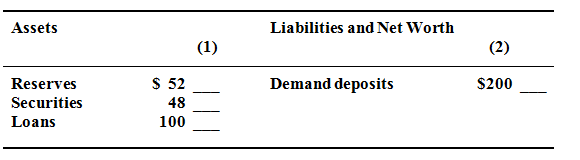
Assume the simplified consolidated balance sheet illustrated below is for the whole chartered banking system. All of the figures are in billions. Desired reserve ratio =25 %.
1575_simplified consolidated balance sheet.png

a. What amount of excess reserves does the chartered banking system hold? Determine maximum amount the banking system might lend? Illustrate in column 1 how the consolidated balance sheet would appear after this amount has been lent. Determine the monetary multiplier?

b. Answer the questions in part a supposing that the reserve ratio is 20 %. Describe the resulting differentiation in the lending ability of the chartered banking system.


E

Expert

Verified

(a) Desired reserves is $50 billion (= 25% of $200 billion); thus excess reserves will be $2 billion (= $52 billion - $50 billion).  Maximum amount that banking system can lend is $8 billion (= 1/.25 - $2 billion).  Column (1) of Assets data =$52 billion; $48 billion; $108 billion.  Column (1) of Liabilities data= $208 billion.  Monetary multiplier is 4 (= 1/.25).

(b) Desired reserves = $40 billion (= 20% of $200 billion); thus excess reserves = $12 billion (= $52 billion - $40 billion).  Maximum amount banking system can lend = $60 billion (= 1/.20 - $12 billion).  Column (1) data for assets after loans (top to bottom); $52 billion; $48 billion; $160 billion.  Column (1) data for liabilities after loans:  $260 billion.  Monetary multiplier = 5 (= 1/.20).  The decrease in the reserve ratio increases the banking system’s excess reserves from $2 billion to $12 billion and enhances the size of the monetary multiplier from 4 to 5.  Lending capacity becomes 5 - $12 = $60 billion.


   Related Questions in Finance Basics

  • Q : How do flotation costs influence the

    Normal 0 false false

  • Q : What is Sinking Fund Sinking Fund : It

    Sinking Fund: It is a fund or account in which money is deposited at customary intervals to offer for the retirement of bonded debt.

  • Q : Mergers encourage the formation of new

    Do mergers encourage the formation of new banks? Yes. The increase in the number of new banks in the second half of the 1990s coincides with a surge in merger activity in the similar period. A study conducted through the Federal Reserve Bank of

  • Q : What is the schedule of Federal Funds

    What is the schedule of Federal Funds and Reimbursements, Supplementary: The supplemental schedule proposed by departments throughout budget preparation that exhibits the federal receipts and reimbursements through source.

  • Q : Near-term policy Normal 0 false false

    Normal 0 false false

  • Q : Explain working of accounts receivable

    Explain working of accounts receivable factoring? And describe benefits to the two parties involved and risks? Factoring is while one firm sells accounts receivable (AR) to another. The purchasing firm is termed as a factor. The factor earns

  • Q : Define the term floor Floor: The

    Floor: The Assembly or Senate chambers or the word employed to explain the location of a bill or the kind of session. Matters might be termed to as “on the floor”.

  • Q : Meaning of invisible hand Normal 0

    Normal 0 false false

  • Q : Define Programs Programs : The

    Programs: The activities of an association grouped on the basis of common objectives. The programs are included of elements that can be further classified into tasks and components.

  • Q : Define Spot Bill Spot Bill : It is an

    Spot Bill: It is an introduced bill which makes non-substantive modifications in a law, generally with the intent to amend the bill at a later date to comprise substantive law modifications. This procedure gives a means for circumventing the deadline