--%>

Profit-maximizing monopolistic competitor charging

When price discrimination is not possible this profit-maximizing monopolistic competitor charges a price of $______ as well as produces ___________ units of output: (w) $12 || 5 thousand. (x) $15 || 8 thousand. (y) $16 || 7 thousand. (z) $18 || 5 thousand.
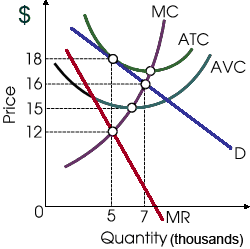
601_Monopolistic Competition1.png

Can anybody suggest me the proper explanation for given problem regarding Economics generally?

   Related Questions in Microeconomics

  • Q : Operating competitors with market power

    A firm operating along with a lot of competitors but that still has some control over price is a: (i) pure quantity adjuster. (ii) member of an oligopoly. (iii) purely competitive firm. (iv) firm with some market power. (v) cartel.

  • Q : Completely elastic price of demand On

    On such demand curve, the demand for DVD games is completely elastic at a price of: (w) $50. (x) $25. (y) $20. (z) None of the above.

    Q : College loan-Rational Ignorance Assume

    Assume that a student takes out a college loan which needs 12% annual interest, however later learns that his aunt makes loans to the family members at 5% interest. The student has suffered from the problem termed as: (1) Rational ignorance. (2) Blind indifference. (3

  • Q : Explain about term market failure The

    The phrase "market failure" refers to: (w) the failure of market economies to deal with social problems. (x) the Stock Market Crash of 1929. (y) cases where supplies and demands within private markets yield inefficiency, excessive or inequity instabil

  • Q : Maximize profit or minimizes losses

    Assume that a monopolist faces a demand curve that is higher at several output levels than is the firm’s average variable cost curve. Therefore the firm will generate where MR is equal to MC to maximize: (w) total revenue. (x) consumer surplus.

  • Q : Interdependent decision of oligopolies

    Interdependent decision making through firms is most common within: (w) purely competitive industries. (x) monopolized industries. (y) oligopolies. (z) monopolistic competition. Please choose the right answer from

  • Q : Illustration of kinked demand curve

    Sarah, Courtney, Carly and Lisa sell shell necklaces. As Lisa lowers her price, Carly, Sarah as well as Courtney lower their price. If Lisa raises her price, Carly, Courtney and Sarah remain their price similar. This interaction is an

  • Q : Low-income elasticities of demand

    Placing an excise tax upon goods along with low-income elasticities of demand will share out the tax burden as: (1) proportionally between high-income and low-income households. (2) disproportionately on high-income households. (3) disproportionately

  • Q : Question based on balance sheets Help

    Help me to solve this problem. Refer to the given balance sheets. If the reserve ratio is 25%, the maximum money-creating potential of the commercial banking system is: A) $36. B) $17. C) $48. D) $24.

    Q : Resources to escape state of destitution

    When an individual or family lacks adequate resources to escape a state of destitution, their circumstances are described as: (1) involuntary poverty. (2) relative poverty. (3) a vicious cycle of poverty (4) institutional poverty. (5) a culture of pov