--%>

Profit-maximizing competitor in short run shutdown point

This profit-maximizing pure competitor would close down within the short run when the price fell below the price resultant to: (i) point c. (ii) point d. (iii) point e. (iv) point f. (v) point g.
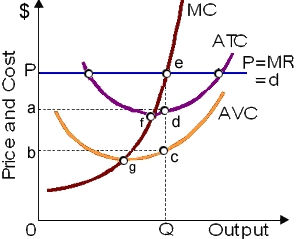
2441_Total Revenue2.png

I need a good answer on the topic of Economics problems. Please give me your suggestion for the same by using above options.

   Related Questions in Microeconomics

  • Q : What is the equilibrium price For each

    For each case listed below, first state whether the change results in an increase or a decrease in demand, or in an increase or a decrease in supply.  Second, determine the direction of change in both the equilibrium price and the equilibrium quantity. a.     

  • Q : Problem regarding Principal Agent The

    The baseball manager, whose players decline to bunt occasionally, rather always swinging for the homeruns, faces a: (i) Second-mover drawback. (ii) Prisoner’s dilemma. (iii) Principal-agent problem. (iv) Grim strategy. Can so

  • Q : Exceed elasticity of demand When the

    When the price of a good increase slightly, then total revenue: (w) falls in the inelastic range of the demand curve. (x) rises over the elastic range of the demand curve. (y) stays close to zero in the unitary-elastic range of the de

  • Q : Compute Gini Index The areas

    The areas illustrates in this Lorenz diagram can be used to compute a Gini index as: (i) (cow + pig)/cow. (ii) cow2/(cow + pig).  (iii) pig2/(cow + pig). (iv) cow/(cow + pig) (v) (cow + horse)/pig.

    Q : Intermediate Oligopoly Why is demand

    Why is demand curve is beneath oligopoly indeterminate (i.e., uncertain)? Answer: Demand curve is indeterminate since of price war among sellers.

  • Q : Boosting total revenue by elastic price

    Price hikes for DVD games will boost total revenue providing the price is: (w) located on this demand curve. (x) above $30. (y) below $30. (z) below $25.

    Q : Downward-sloping demand curve The law

    The law of demand is graphically demonstrated by: (1) Movement all along the supply curve. (2) The downward-sloping demand curve. (3) The rightward shift of demand curve. (4) Shifting of production possibilities. C

  • Q : Labor History-Yellow Dog Contracts

    Can someone help me in finding out the right answer from the given options. The worker who signed a yellow dog contract in the year 1920s agreed: (1) To support the union’s feather-bedding efforts. (2) Not to work with the ‘scab’ non-union strike-bre

  • Q : Walfare function expected utility

    please help me in doing the attached documents

  • Q : Labor Productivity in Economic Capital

    Labor productivity tends to rise while: (1) the K/L ratio increases. (2) the K/L ratio decreases. (3) workers forego education. (4) capital becomes more expensive. (5) wage levels fall. Please choose the right answ