--%>

Compute Gini Index

The areas illustrates in this Lorenz diagram can be used to compute a Gini index as: (i) (cow + pig)/cow. (ii) cow2/(cow + pig).  (iii) pig2/(cow + pig). (iv) cow/(cow + pig) (v) (cow + horse)/pig.
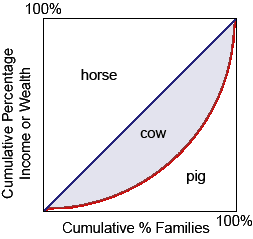
997_Lorenz Curve Problem.png

Can anybody suggest me the proper explanation for given problem regarding Economics generally?

   Related Questions in Microeconomics

  • Q : Low marginal tax with basic income In a

    In a negative income tax system, where a combining fundamental income floor with low marginal tax rates gives in: (w) reduced incentives for “voluntary poverty.” (x) higher minimal standards of living for the poor. (y) an

  • Q : Point of hiring labor for profit

    The entire profit maximizing firm will hire additional labor up to the point where the: (i) Average physical product of the labor equivalents the nominal wage. (ii) Last unit of labor adds equally to net revenue and net cost. (iii) Marginal product of the labor is at

  • Q : Numerical problem on Relative Prices

    When the market price of a gallon of gas is similar as the cost of 4 pineapples in dollars, the relative price of the pineapple is: (i) 1/4 of a gallon of gas. (ii) 25 cents. (iii) 4 gallons of gas. (iv) $4.00. Can someone please h

  • Q : Reason why giant corporations dominate

    John Kenneth Galbraith refuses theories which suppose profit maximization in competitive markets. According to him, the big corporations dominate the economic activity as: (1) Corporate managers look for maximum gains for stockholders. (2) Government policies are mani

  • Q : Problem on Consumer Sovereignty The

    The phrase ‘dollar votes’ refers to the consumers: (1) Voting patterns in the national elections. (2) Recognizing what goods are produced. (3) Each containing an equivalent says about what is generated. (4) Being subservient to big firms.

    Q : Adjustments in demand When Mad Cow

    When Mad Cow Disease erupted internationally, so what would occur to the demand, price, supply and quantity of hamburgers: (w) demand = fall, price = ???, supply = fall and quantity = fall. (x) demand = fall, price = rise, supply = rise and quantity =

  • Q : Price equality to marginal costs A

    A nondiscriminating monopolist's equilibrium output is inconsistent along with: (w) marginal revenue equals marginal cost [MR = MC]. (x) price equal to marginal costs [P = MC]. (y) price exceeding average variable costs [P > AVC]. (z) price exceedi

  • Q : Typical production possibilities curve

    Evaluate which one is not correct? A typical production possibilities curve: A) indicates how much of two products a society can produce. B) reveals how much each additional unit of one product will cost in terms of the other product. C) specifies how much of each pro

  • Q : Accounting profits when economic profit

    Whenever economic profit equivalents zero, then the accounting profits: (i) Are explicit costs of the remaining in business. (ii) Will induce raised investment even when accounting costs are much low. (iii) Are too zero. (iv) Reflect normal returns on the investment t

  • Q : Quantity demanded of good What cause do

    What cause do heterodox economists employ to argue that the quantity demanded of good is a not a function of its price but of the family’s (consumer’s) income? And also discuss, For heterodox economists, household choice is not regarding maximizing utility