--%>

Problem on prisoners dilemma game

Lets assume an infinitely repeated prisoner’s dilemma game by two players. The resulting payoffs at each phase by the actions of two players are illustrated below in the table (payoffs are symbolized like (payoff for player 1, payoff for player 2)). Two players find out their strategies simultaneously and independently to maximize the expected payoffs of their own based on their information. The game is potentially infinitely repeated, though the game ends at a probability of 1–x (0≤1–x≤1) in every phase (that is, such players continue to play this game at the probability of x). There is no discount rate for the future payoffs (that is,  both players weight current and future payoffs equally).
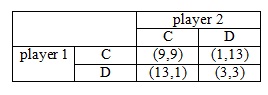
1139_game.jpg

(a) Assume two players adopt a Trigger Strategy (Play C in the first phase In the tth phase(t≥2), if the outcome of all t–1 preceding stages has been (9, 9), then play C; or else play D). Find the range of x which makes cooperation self-sustainable.

(b) Assume two players adopt a Tit for Tat Strategy (TFT) (Play C in the first phase And then, do whatever the other player did at the previous phase). Find the range of x which makes cooperation self-sustainable.

   Related Questions in Business Economics

  • Q : Illustrate receipts from several

    Illustrate how receipts come from several sources in Federal Finance?

  • Q : Explain about the principle of

    Economic efficiency needs that, relative to the other goods which different individuals might consume, the people who value exact goods relatively the most should own and/or use all goods. Such principle is termed as: (i) economic equity. (ii) allocat

  • Q : Explain a refutation of the doctrines

    Adam Smith wrote his Wealth of Nations within part like a refutation of the doctrines: (1) classical liberalism. (2) utilitarianism. (3) mercantilism. (4) physiocracy. (5) laissez faire capitalism.

  • Q : What does high or low operating

    What does high or low operating leverage specify?

  • Q : Estimate the impact of education on

    Using a random sample of 670 individuals for the population of people in the workforce in 1976, we want to estimate the impact of education on wages. Let wage denote hourly wage in 1976 U.S. dollars and let educ denote years of schooling. We obtain the following OLS regression line: wage = -0.54

  • Q : Introduction of the term Operating

    Give a brief introduction of the term Operating Leverage?

  • Q : Economic crisis situation in Europe

    Question: Describe the present economic crisis situation in Europe.   Why has it been so difficult for the Europeans to find a solution to this problem?   Comment on what implications the crisis may have for the rest of the world i

  • Q : Explaination on Economical Management

    ECONOMICS Explain why each of the following statements is True, False, or Uncertain according to economic principles. Use diagrams where appropriate. Unsupported answers will receive no marks. It is the ex

  • Q : Describe Net income approach Briefly

    Briefly describe Net income approach? Named who recommended this theory?

  • Q : What is an Economic Territory Economic

    Economic Territory: This refers to the region of a country where there is a free movement of goods, capital and human resources.