--%>

Problem on money diagram

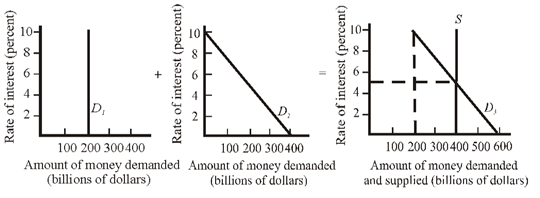
Help me to go through this problem. Refer to the given market for money diagrams. If the interest rate was at 8 percent, people would: A) sell bonds, which would cause bond prices to fall and the interest rate to fall. B) buy bonds, which would cause bond prices to rise and the interest rate to fall. C) have insufficient liquidity, which would cause them to reduce their spending on consumer goods. D) buy bonds, which would cause bond prices to fall and the interest rate to rise.
1582_6.png

   Related Questions in Microeconomics

  • Q : Elastic industry What industry is

    What industry is perfectly elastic that is not agriculture?

  • Q : Commercial introduction of production

    Innovation: (w) entails financial investment to create human capital. (x) comprises the commercial introduction of a new product or production process. (y) can reasonably describe only normal accounting profit. (z) was used by John Maynard Keynes to d

  • Q : Leftward shift of PPC What does

    What does leftward shift of PPC point out? Answer: It points out underutilization of resources.

  • Q : Marginal revenue of individual

    For an individual price-taker firm, marginal revenue is: (w) another term for profit. (x) constant and equal to price. (y) less than price. (z) negatively sloped. I need a good answer on the topic

  • Q : Limitation of marginal revenue Marginal

    Marginal revenue is NOT: (i) similar as average revenue or price for a competitive firm. (ii) identical to the price of output for firms along with monopoly power. (iii) specified by (change in TR)/ (change into Q) for all firms. (iv) derived by the d

  • Q : Define Marginal Utility Marginal

    Marginal Utility: It is addition more to the net or total utility as consumption is increased by one more unit of commodity.

  • Q : Determine present value of future income

    The present value of future income is: (1) calculated by multiplying future income by the percentage interest rate. (2) higher, the higher the interest rate. (3) lower, the higher the interest rate. (4) unaffected by the interest rate. (5) purely obje

  • Q : When would transaction cost be zero All

    All transaction costs would be zero when: (1) Congress required current prices to be cut by eighteen percent. (2) market information and transportation were both costless. (3) market prices were legally restricted to production costs. (4) inflation we

  • Q : What is an Indifference curve

    Indifference curve: It is the combination of two goods that provides consumer similar level of satisfaction.

  • Q : Selling price by price elasticity of

    At the point upon the demand curve for Silver Screen Classic DVDs, here the price elasticity of demand is unitary, the price would be approximately: (i) $10, resulting in roughly 8 million DVDs being sold. (ii) $13, resulting in appro