--%>

Price elasticity and market power

The price elasticity of demand equals one when this firm produces where total revenue is: (i) $72,000 per period. (ii) $80,000 per period. (iii) $96,000 per period. (iv) $100,000 per period. (v) $144,000 per period.
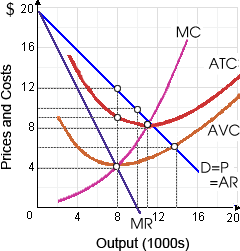
1027_Price Discrimination.png

Hey friends please give your opinion for the problem of Economics that is given above.

   Related Questions in Microeconomics

  • Q : Complementary Goods-Decreasing price of

    A reduction in the price of vanilla ice-cream is likely to raise the demand for: (i) Chocolate syrup. (ii) Yogurt. (iii) Watermelon. (iv) Cookies (v) Textbooks. Can someone please help me in finding out the accurate answer from the

  • Q : Demand and supply An increase in

    An increase in consumer desire for strawberries is most likely to: A) increase the number of strawberry pickers needed by farmers. B) reduce the supply of strawberries. C) reduce the number of people willing to pick strawberries. D) reduce the need for strawberry pic

  • Q : Define Size Anomaly Size Anomaly : The

    Size Anomaly: The size effect terms to the negative relation among security returns and the market value of the common equity of a firm. The coefficient on size has extra explanatory power than the coefficient on beta in explaining the cross section o

  • Q : Graphical shift of supply curve When

    When market supply and demand curves for Velcro shoelaces were projected into a screen at the front of this room, a raise in the supply of Velcro shoelaces would be illustrated graphically by a shift of supply curve: (1) Towards the center of Earth. (2) To the left. (

  • Q : Collapse of Cartels A purpose NOT often

    A purpose NOT often cited for the collapse of cartels would be: (w) price cheating. (x) inability to deter entry. (y) government prosecution. (z) merger into monopoly. Hey friends please give your opinion for the p

  • Q : Indeterminable market supply curve For

    For a monopoly firm a market supply curve is: (w) steeper than the market supply curve of a competitive industry. (x) indeterminable because profit-maximizing quantities with profit maximizing prices are determined concurrently, and depend upon costs

  • Q : Supply of labor at different wage rates

    The time people are willing and capable to work at different wage rates throughout a given period is termed as the: (1) supply of labor. (2) labor force participation rate. (3) marginal product of labor. (4) labor theory of value.

    Q : Limitation of marginal revenue Marginal

    Marginal revenue is NOT: (i) similar as average revenue or price for a competitive firm. (ii) identical to the price of output for firms along with monopoly power. (iii) specified by (change in TR)/ (change into Q) for all firms. (iv) derived by the d

  • Q : Profit maximized by nondiscriminating

    A nondiscriminating unregulated monopolist maximizes profit by: (w) charging the highest price the market will bear. (x) often changing designs and building in planned obsolescence. (y) setting marginal costs equal to marginal revenue [MC = MR]. (z) s

  • Q : Define production possibility curve or

    Production possibility curve or PPC: PPC exhibits different combination of a pair of goods, that can be produced with the given resources and method of production, that are fully and proficiently utilized.