--%>

Market shift when exporting

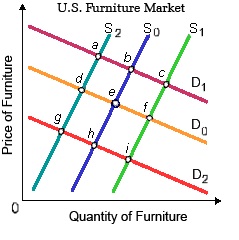
When the U.S. furniture market is primarily in equilibrium at point e on S0D0 and then Chinese manufacturers start exporting more furniture to the United States, then this market would shift towards a new equilibrium at: (1) point a. (2) point b. (3) point c. (4) point d. (5) point f.
884_5.jpg

Can someone help me in getting through this problem.

   Related Questions in Macroeconomics

  • Q : Physical quality of life index DISCUSS

    DISCUSS the experience of high GNP countries and low GNP with regard to PQLI.

  • Q : Cost of a foreign currency When cost of

    When cost of a foreign currency increases its supply too increases. Elucidate why?

  • Q : Fiscal and Monetary policies How can

    How can governments seek to control their national economies through fiscal and monetary policies?

  • Q : Aggregate Expenditure model Describe

    Describe Aggregate Expenditure model and also state AD/AS model?

  • Q : Microeconomics concepts as a primary

    Write a 3 page paper using microeconomics concepts as a primary mode of analysis.  Your paper should use 1.5 line spacing, a 12 point font, and 1inch margins.  Proof read your paper.  You will lose 5 percentage points per day for each day past the

  • Q : Problem on equivalent Consumer Surplus

    Tom reimburses $5.00 for a ticket to see a present hit movie. If Tom was willing to reimburse up to $7.00 for that ticket, his consumer surplus equals: (1) $5.00 (2) $2.00 (3) $7.00 (4) Tom does not receive any consumer surplus as he purchased the ticket.

  • Q : Normative macroeconomic policy

    Widely accepted normative macroeconomic policy objectives include: (w) full employment and economic development. (x) allocative, productive, and distributive efficiency. (y) maximum freedom and economic profits. (z) job security and equality within th

  • Q : Total revenue when price modify When

    When total revenue to a firm is unaffected by small price modifications, then demand is: (i) Relatively price elastic. (ii) Relatively price inelastic. (iii) Unitarily price elastic. (iv) Vertical. (v) Horizontal. Can someone help

  • Q : Tariffs Tariffs: -are also called

    Tariffs: -are also called import quotas. -may be imposed either to raise revenue (revenue tariffs) or to shield domestic producers from foreign competition (protective tariffs). -are per unit subsidies designed to promote exports. -are excise taxes on goods exported abroad.

  • Q : Principles of macroeconomics Explain

    Explain the concept of “economies of scale” and “increasing returns”.