--%>

Market period disequilibrium

At the price P1, this purely competitive Christmas tree industry is within: (w) long-run equilibrium. (x) short-run equilibrium. (y) market period disequilibrium. (z) short-run disequilibrium.
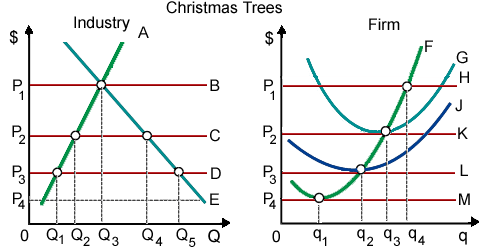
2076_supply and demand1.png

Hello guys I want your advice. Please recommend some views for above Economics problems.

   Related Questions in Microeconomics

  • Q : Monopsony Power-Demand for Labor Can

    Can someone help me in finding out the right answer from the given options. After adjusting for the inflation, Alex Rodriquez’s salary with NY Yankees was very higher in 2006 than Henry Aaron's salary with Atlanta Braves in the year 1970s that implies that: (i)

  • Q : Point of hiring labor for profit

    The entire profit maximizing firm will hire additional labor up to the point where the: (i) Average physical product of the labor equivalents the nominal wage. (ii) Last unit of labor adds equally to net revenue and net cost. (iii) Marginal product of the labor is at

  • Q : State microeconomic Choose

    Choose microeconomic statement from following A) The real domestic output increased by 2.5 percent last year. B) Unemployment was 6.8 percent of the labor force last year. C) The price of personal computers declined last year. D) The general price level increased by 4

  • Q : Reduces total production cost and raise

    Assume that Joe discovers the price elasticity of market demand to be 0.8 for Joe’s additional fancy dehydrated water at the present price of $10 per barrel. Every barrel averages $2 to generate. Joe can: (w) increase his profits by 80% if he in

  • Q : Problem relating to Changes in Demand

    Airlines considerably decreased the number of flights accessible in the year 2005, as compared to flight availability during the year 2000. Passenger mileage was fall. Economists would be least possible to ascribe the decline in airline ticket sales throughout the ear

  • Q : Estimate profit-maximizing price The

    The profit-maximizing price for RoboMaids is: (1) $24,000 per robot. (2) $20,000 per robot. (3) $16,000 per robot. (4) $12,000 per robot. (5) $10,000 per robot.

    Q : Typical purely competitive firm in

    The typical purely competitive firm: (w) is both a price maker and a quantity adjuster. (x) operates within the inelastic range of the demand curve. (y) should decide how much to produce at prices set through the market. (z) tries to maximize total sa

  • Q : Define cost Cost : This refers to the

    Cost: This refers to the money expenses acquired on the production of a specified amount of commodity.

  • Q : Purely competitive market and constant

    When this firm is typical in illustrated figure of this purely competitive market and when this is a constant-cost industry, in that case the long run supply curve for the industry is a horizontal line which would go from: (1) point c

  • Q : Short-run supply curve of the firm For

    For a competitive firm the short-run supply curve is the: (w) marginal cost curve which is above the average total cost curve. (x) marginal cost curve which is above the average variable cost curve. (y) upward sloping part of the marginal cost curve.